Frogs of Borneo

Frogs of Borneo

Frogs of Borneo

Frogs of Borneo

Frogs of Borneo

Frogs of Borneo

Frogs of Borneo

Frogs of Borneo

Frogs of Borneo

Frogs of Borneo

Frogs of Borneo
Filter
Leptobrachium montanum
Highland primary and secondary forests at elevations between 900–1685 m a.s.l. Tadpoles are not adapted to strong current and are consistently found on rocky substrates or in quiet sections of streams with low to moderate flow. They inhabit the bottom layers of streams. Frequently, mixed developmental stages occur within the same stream, indicating that breeding activity extends over a prolonged period. Metamorphosis likely requires a relatively long time.
-
Family:Megophryidae
-
Genus:Leptobrachium
-
Ecomorph:benthic, exotrophic, lotic
-
Waterbody Type:flowing
-
Water Column:bottom
-
Feeding Type:feeding, generalist
-
Size:72 mm
-
Development:larva, tadpole
-
Adult:Leptobrachium
Coloration
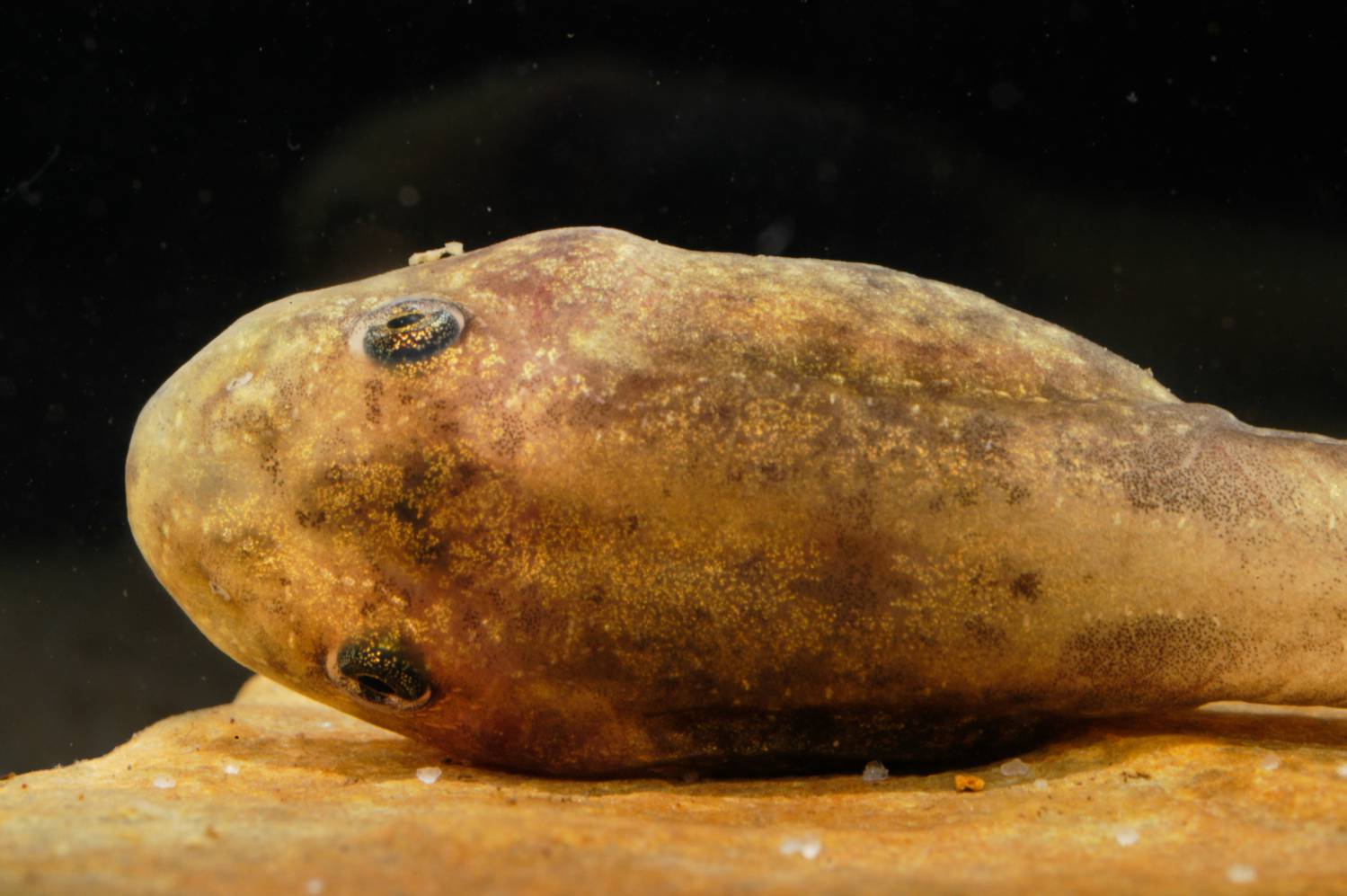
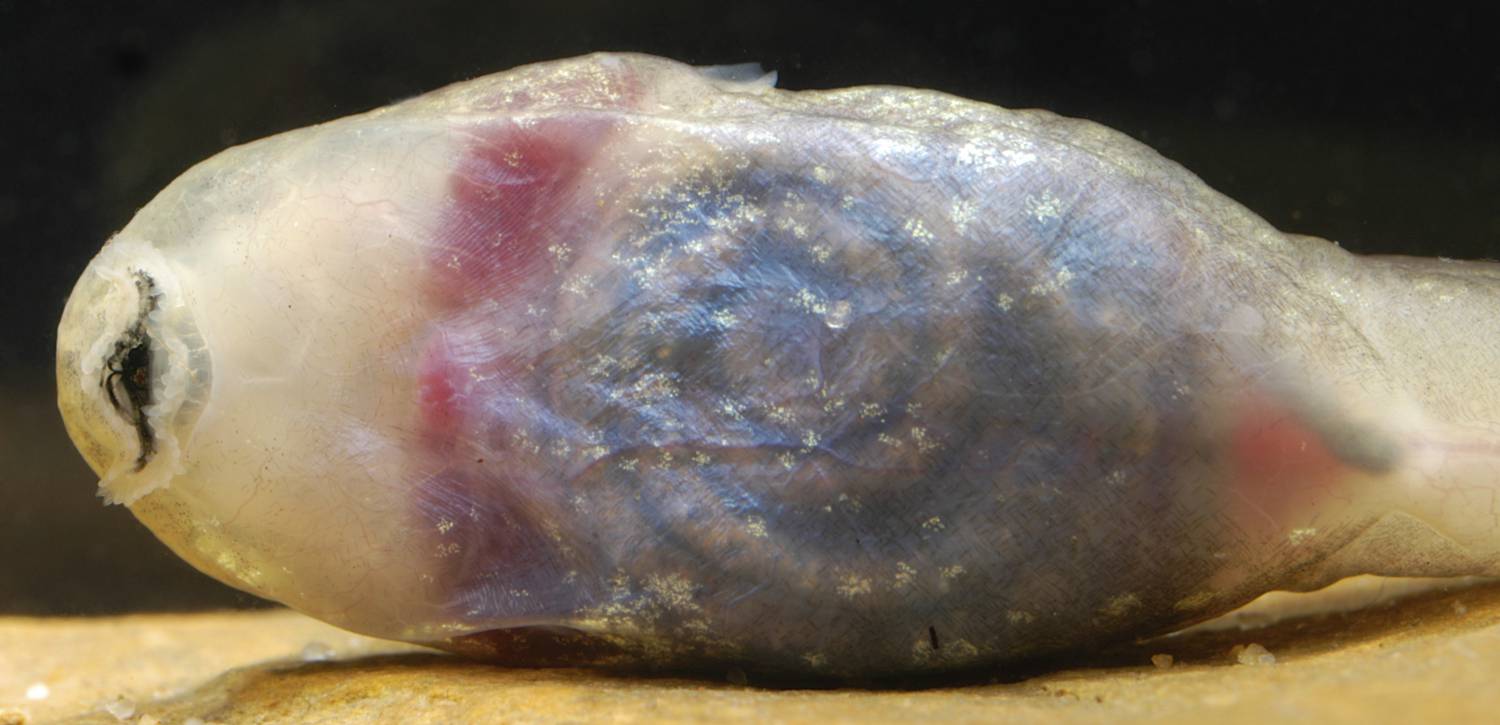
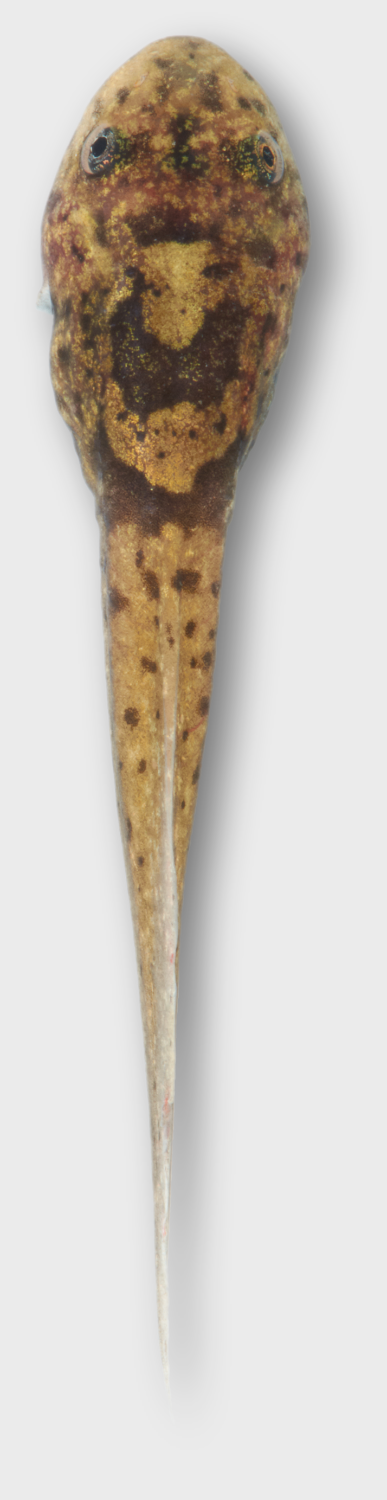
Advanced larval stages are generally dark brown dorsally, with dark markings on a somewhat lighter background; earlier stages are less darkly pigmented. Distinct dark blotches are present at the base of the tail. Young individuals bear a pair of whitish structures at the posterior end of the head region. Golden iridophores occur in patches dorsally and laterally, and to a lesser extent ventrally. In close-up view, a hatched pattern of pigment cells is evident. The ventral surface is semitranslucent to opaque, depending on developmental stage. The gut coil is visible, at least faintly, and more distinctly in early stages. In life, the abdominal skin shows a bluish-silvery iridescence, which is absent in preserved specimens. Buccal and gular regions are mostly translucent and weakly pigmented. Gills and heart are visible and red. Body coloration continues onto the muscular portion of the tail. Distally, the pattern breaks up into blotches and spots on both the muscular and fin portions of the tail. Myosepta, lateral line, and lateral tail vein are visible.
Snout
Broadly rounded, blunt, and moderately long in dorsal view. The portion anterior to the nostrils is slightly set off in dorsal view. In lateral view, the head slopes smoothly into a rounded snout. The snout is slightly bulging at the level of the nostrils.
Oral Disc
The oral disc is anteroventral to almost ventral in position and less than half the body width. Emarginations between the upper and lower lips are indistinct. Both lips bear relatively large, bluntly conical marginal papillae arranged in a single, nearly continuous row, with a small medial gap in the upper lip papillation. The first anterior papilla adjacent to this gap is broadened. A few scattered submarginal papillae are present on the lateral portions of the lower lip. The keratodont formula ranges from LTRF 5(2–5)/5(1–4) to 7(2–7)/6(1–5), variably with additional short submarginal rows laterally. The first upper lip keratodont row is very short. Jaw sheaths are massive, well keratinized, black, and bear coarse serrations along their edges.
Body
Large. In lateral view, the head and trunk are slightly dorsoventrally depressed. In dorsal view, the body is elongate oval and clearly wider than the base of the tail. Maximum body width is reached at the anterior trunk, posterior to the gill chambers. The spiracle is sinistral and opens posterolaterally; its orifice is positioned approximately at mid-body level in lateral view. In most specimens, the spiracular rim is free and forms a short tube. Lateral line organs are distinct and visible as broken, dash-like lines. Myosepta are indistinct. The lateral tail vein is visible.
Eyes & Nostrils
Eyes are positioned dorsolaterally. The iris and scleral portion of the eye are black with densely scattered silvery or golden iridophores. The nostril is distinct, mostly unpigmented, and positioned closer to the snout than to the eye. It is oriented anterolaterally, and the dorsal rim bears a small projection.
Tail
The tail comprises 66–67% of the total length. The muscular portion is strong and nearly as high as the body in lateral view. The upper fin rises slowly from the trunk-tail junction, remains almost straight to mid-tail, then changes direction and descends in a shallow arch toward a narrowly rounded tip. The lower fin originates at the trunk-tail junction and remains low, with a shallowly arched contour. Maximum height of the tail and tail fins is reached approximately at mid-tail. The upper fin is higher than the lower fin. Skin glands are absent.
Similar Species
Tadpoles of Leptobrachium are readily assigned to the genus based on their association with rocky streams, generally dark coloration, large size, and distinctive oral disc features. However, reliable diagnostic characters separating tadpoles within the genus have not been firmly established. With respect to L. abbotti, Malkmus et al. (2002) reported the absence of network-like ventral pigmentation on the body and tail of L. montanum. We cannot confirm a complete absence, but found the ventral hatched pigmentation pattern to be much less pronounced in L. montanum tadpoles. The number of submarginal papillae and additional lateral keratodont rows appears variable in both species based on examined material. The anteriormost marginal papilla was broader than the others in some, but not all, L. montanum specimens and may represent either intraspecific variation or a population-specific trait. Leptobrachium nigrops possesses uniformly black tadpoles. The larva of L. kanowitense remains undescribed.
Literature
Males sitting on the ground call at some distance from the slopes of stream banks. The call is a series of relatively deep „quack“ notes. The call frequency is deeper than in the morphologically similar L. gunungense (Malkmus et al. 2002). Males stimulate each other and their rising choruses in the colony may be followed by periods of complete silence.
Inger, R.F., Stuebing, R. B., Grafe, U., Dehling, M. (2017) A Field Guide to the Frogs of Borneo. 3rd ed. Kota Kinabalu: Natural History Publications (Borneo). 228 pp.
Malkmus, R., Manthey, U., Vogel, G., Hoffmann, P., Kosuch, J. (2002) Amphibians & Reptiles of Mount Kinabalu (North Borneo). Koeltz Scientific Books, Königstein. 424 pp.