Zum Hauptinhalt springen

Frogs of Borneo

Frogs of Borneo

Frogs of Borneo

Frogs of Borneo

Frogs of Borneo

Frogs of Borneo

Frogs of Borneo

Frogs of Borneo

Frogs of Borneo

Frogs of Borneo

Frogs of Borneo

Zhangixalus dulitensis

Tadpoles observed in partially sun-exposed, shallow ponds (50 cm) at forest clearings or edges, with intermittent presence. Pond bottoms muddy. Tadpoles more active at night, hiding during the day. Occasionally form aggregations (schools) feeding on benthic particles and algal overgrowth on plants and leaves.
  • Family:
    Rhacophoridae
  • Genus:
    Zhangixalus
  • Ecomorph:
    benthic, exotrophic, lentic
  • Waterbody Type:
    stagnant
  • Water Column:
    bottom
  • Feeding Type:
    feeding, generalist
  • Size:
    34 mm
  • Development:
    larva, tadpole
  • Adult:
    Zhangixalus

Coloration

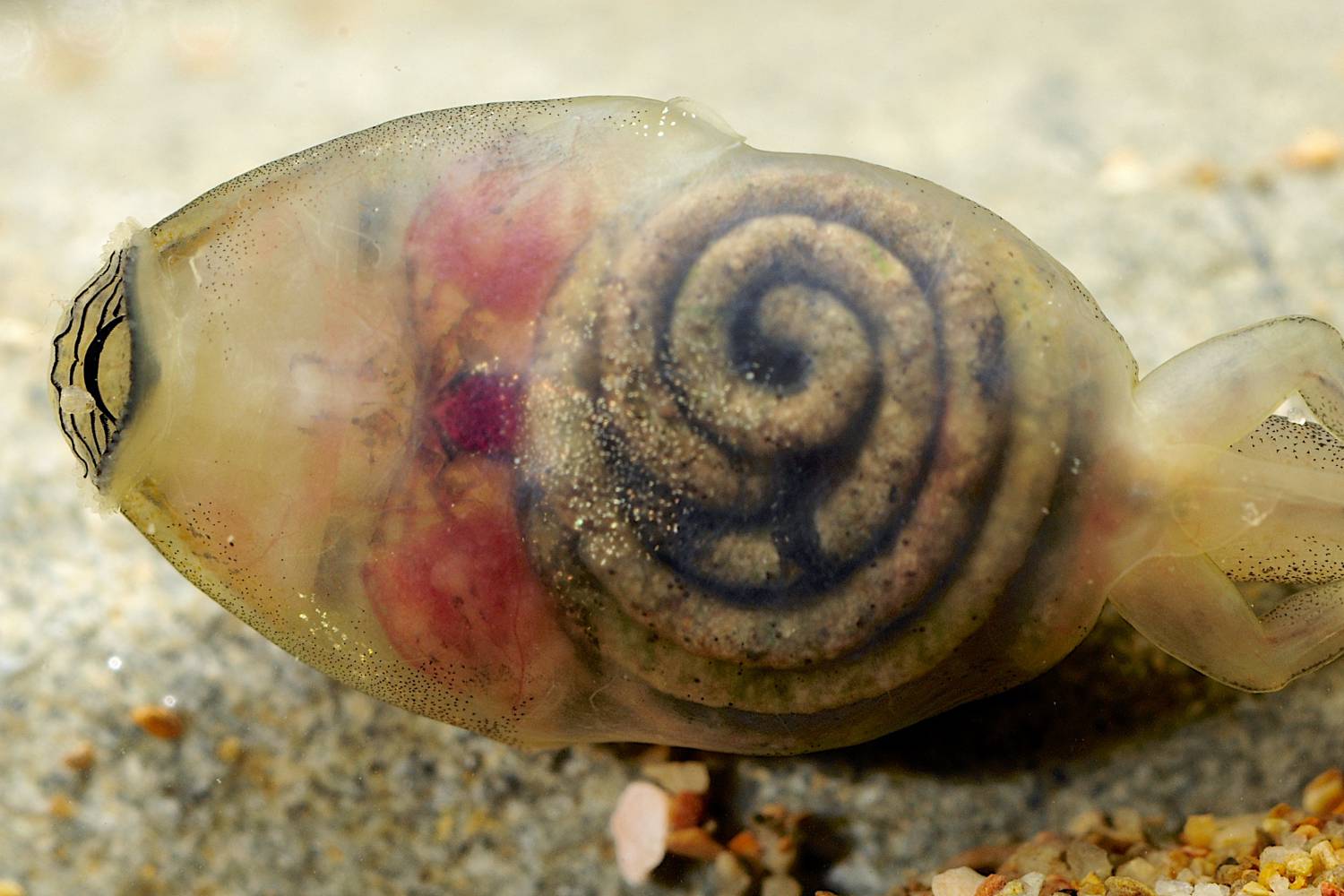
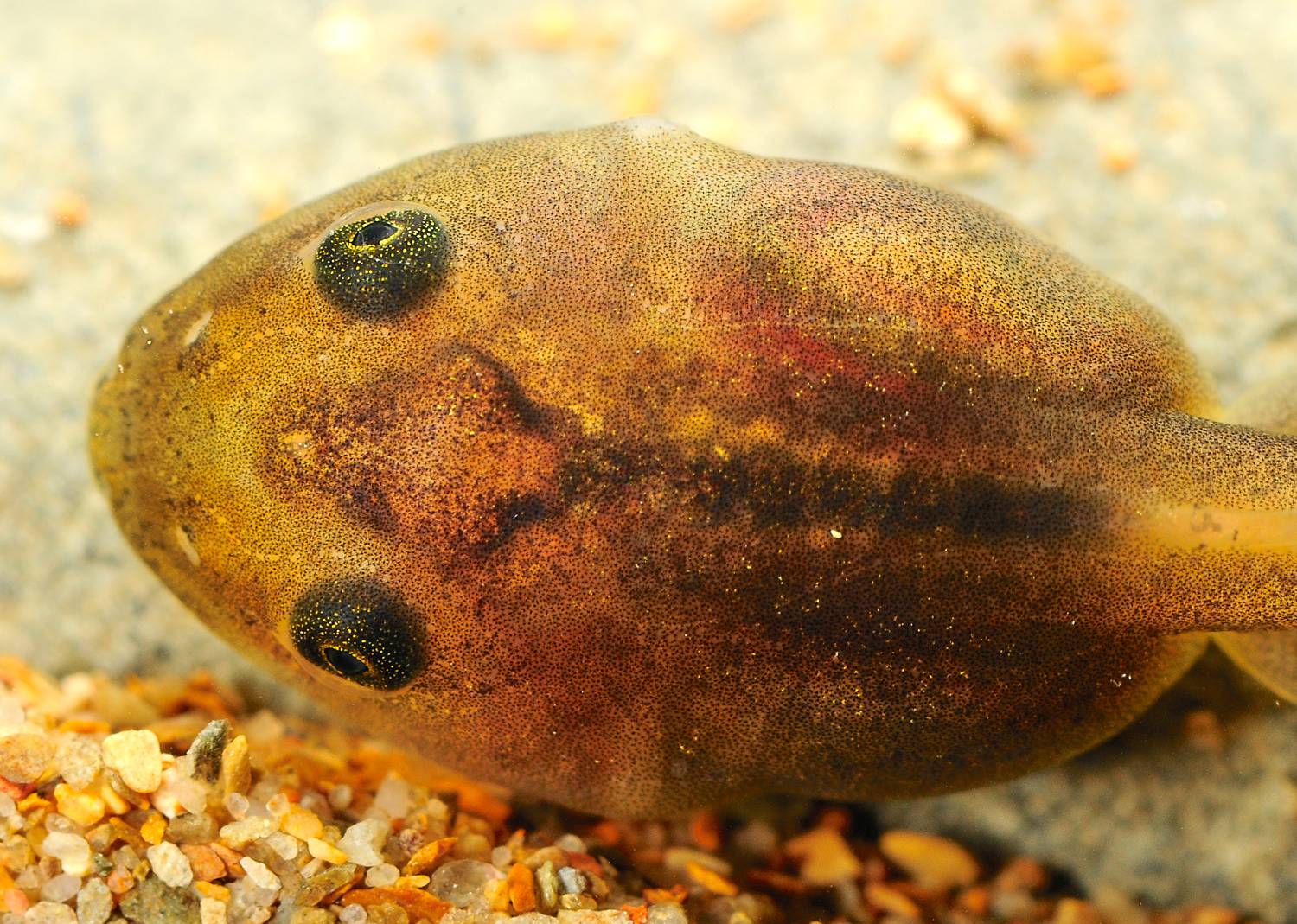
Dorsal coloration ocher to buff brown, overlain by dark, diffuse pigmentation. In dorsal view, melanocytes form a rhomboid pattern above the braincase, extending from anterior to the eyes to the posterior end of the head, transitioning into a dorsal band along the trunk. Lateral view shows a gradual decrease of dorsal pigmentation ventrally. Some individuals display a diffuse dark band from the anteroventral eye corner to the snout, passing below the nostril. Lungs visible through skin as an arched line of shiny bubbles dorsal to gut coils. Ventral skin lightly pigmented and mostly transparent, revealing inner organs. Iridocytes form a medial silvery patch posterior to the heart along the gut. Muscular tail portion dusted with melanocytes, fading toward distal half. Fins mostly clear except at proximal bases. Occasionally 2–3 small dark circles (possible glands) at lateral tail base. Tail venation and myosepta indistinct.

Snout

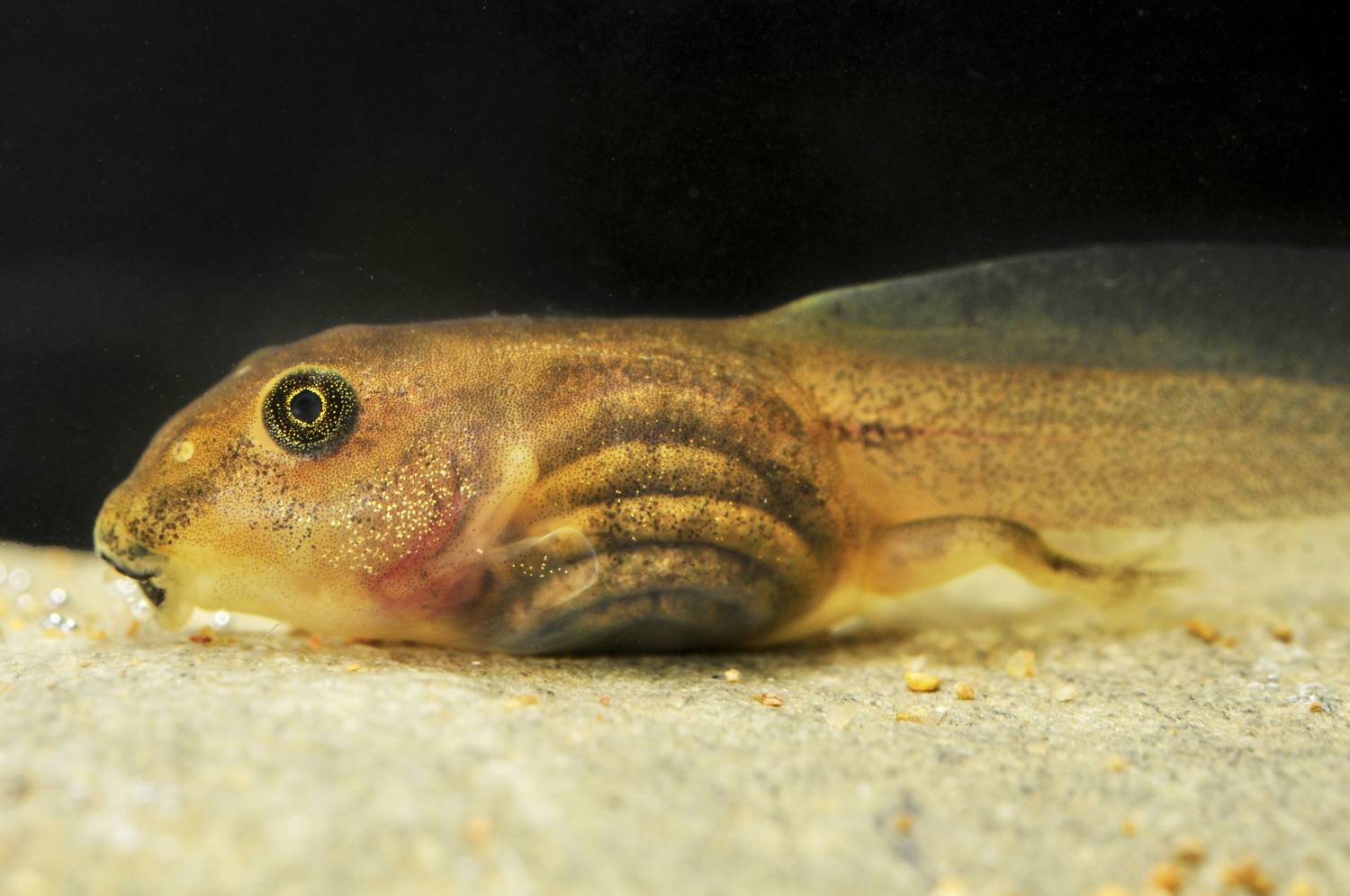
Slightly narrowed in dorsal view. Lateral profile short, steeply convex, with elevated nostrils and a bulging tip, giving a characteristic appearance.

Oral Disc

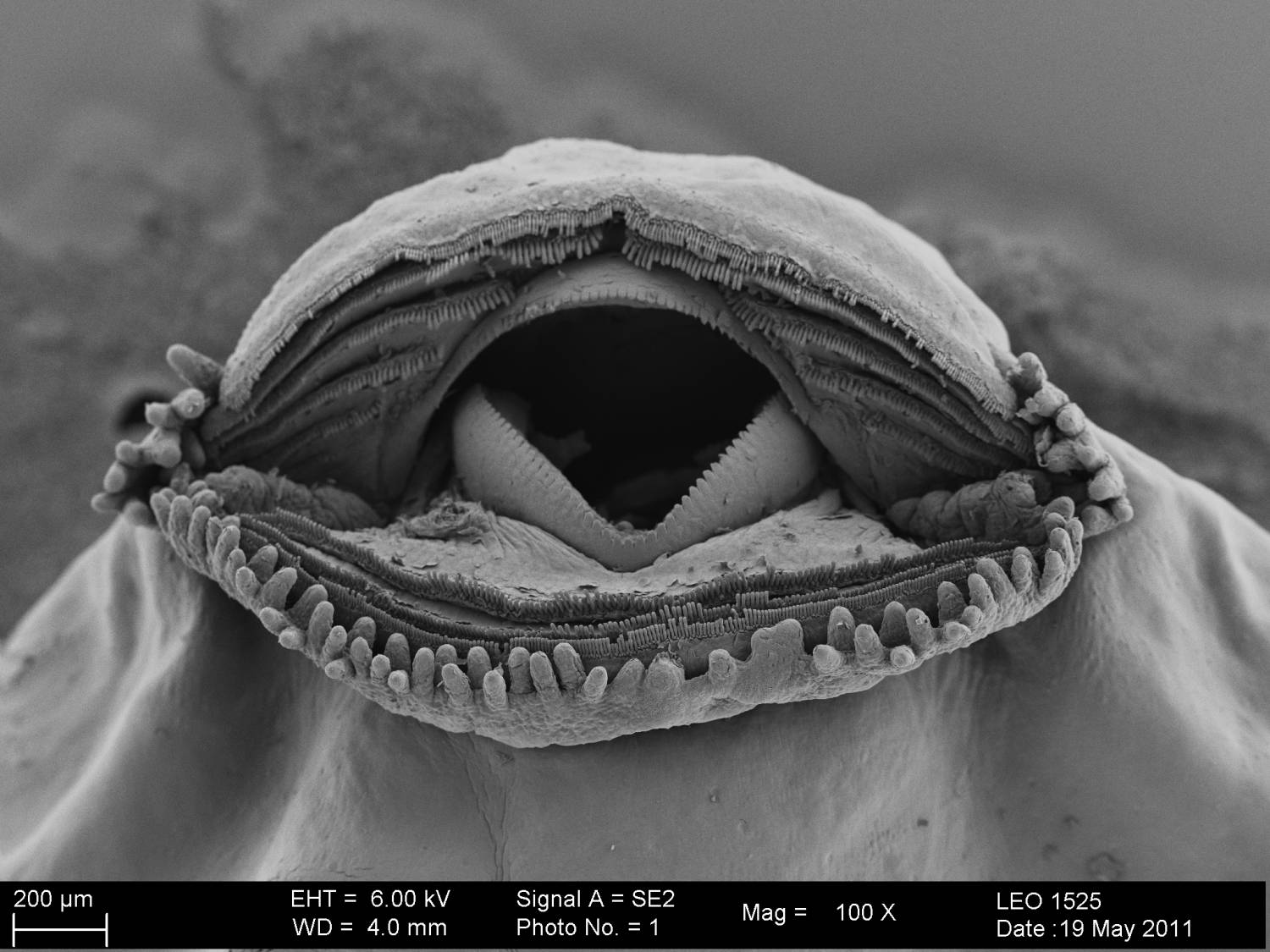
Anteroventral. Width approximately half of maximum body width. Papillae present along lower lip margin and lateral upper lip. Wide medial area of upper lip devoid of papillae. Marginal papillae mostly biserial, short, rounded. LTRF 5(2–5)/3 to 6(2–6)/3. Beaks well keratinized, narrow, with fine sharp serrations. Upper beak broadly arched; lower jaw sheath flat, V-shaped.

Body

Depressed dorsoventrally. Dorsal view shows oval to ovoid body contour, widest at gill level. Spiracle sinistral, low, well below mid-body axis in lateral view. Spiracular tube directed posterodorsally, opening laterally; inner wall attached to body. Spiracular orifice fully rimmed, free tube absent.

Eyes & Nostrils

Eyes dorsolateral, high in lateral view. Pale nostrils elevated, closer to snout than eyes, opening anterolaterally. Iris black with scattered golden pigmentation, forming a dense golden ring around pupil.

Tail

Tail approximately 60% of total length. Upper fin originates at trunk-tail junction along tail musculature. Tail height gradually increases, maximal at mid-tail, tapering posteriorly with flattened curvature to a narrowly rounded tip. Muscular portion moderately high (50% of body height).

Similar Species

Superficially similar to Kurixalus chaseni or early stage Rhacophorus pardalis tadpoles, both may occur in the same pond and R. pardalis often has similar dark markings around the braincase. However, particularly the peculiar snout profile in lateral view identifies Z. dulitensis reliably against the others. Hylarana raniceps and H. megalonesa tadpoles are readily separated from Z. dulitensis by their distinct gland fields. The description of Z. dulitensis tadpoles in Inger et al. (2017) is erroneous and may have been confused with R. borneensis.

Literature

Adults come down from the canopy and gather on vegetation around the pond. The moment when congregations form seems unpredictable. Small foam nests are produced and attached to vegetation overhanging the water. After initial development, tadpoles hatch from the nest and drop into the pond below. Calls of males have been described as a weak cricketlike trill.
Haas, A., Hertwig, S.T., Krings, W., Braskamp, E., Dehling, J.M., Pui, Y.M., Das, I. (2012) Description of three Rhacophorus tadpoles (Lissamphibia: Anura: rhacophoridae) from Sarawak, Malaysia (Borneo). Zootaxa 3328: 1–19.

Inger, R.F. (1985) Tadpoles of the forested regions of Borneo. Fieldiana Zoology new series 26: 1–89. [as Rhacophorus dulitensis]

Inger, R.F., Stuebing, R.B., Grafe, T.U. Dehling, J.M. (2017) A field guide to the frogs of Borneo. 3rd ed. Natural History Books, Kota Kinabalu. 228 pp.