Zum Hauptinhalt springen

Frogs of Borneo

Frogs of Borneo

Frogs of Borneo

Frogs of Borneo

Frogs of Borneo

Frogs of Borneo

Frogs of Borneo

Frogs of Borneo

Frogs of Borneo

Frogs of Borneo

Frogs of Borneo

Philautus acutus

Philautus acutus is an endemic species with a restricted distribution on the island of Borneo. The species is known from the higher elevations of Gunung Mulu National Park, where it inhabits primary upper montane forests at about 1200–1300 m a.s.l.
  • Family:
    Rhacophoridae
  • Genus:
    Philautus
  • Ecomorph:
    direct-development
  • Waterbody Type:
    terrestrial
  • Water Column:
  • Feeding Type:
    non-feeding
  • Size:
    — mm
  • Development:
  • Adult:
    Philautus

Coloration

A broad dark brown bifurcate pattern on a pale tan to clay-brown ground color

Snout

Snout short and rounded.

Oral Disc

Body

Small tree frog (snout-vent length of males 23.4–27.1 mm), with smooth skin and a few small tubercles on the snout, upper eyelid, and occipital region.

Eyes & Nostrils

Tail

Similar Species

For the vast majority of Bornean Philautus species, reproductive behavior has not been confirmed by direct observation, captive breeding, or genetic matching (barcoding) of developmental stages to adults. This lack of basic knowledge hampers both the understanding of their ecology and the reconstruction of the evolution of their reproductive strategies. It remains unclear whether aerial direct development has evolved once or multiple times independently within different lineages of Philautus. Our sample of P. acutus was verified by DNA barcoding. Aerial direct development in Sundaland Philautus has so far been confirmed only for P. acutus and P. saueri. In P. kerangae, P. mjobergi, and P. saueri, egg deposition and incubation in Nepenthes pitchers have been reported. In some anecdotal reports, however, the identity of eggs or developmental stages found in pitchers has not been unequivocally confirmed and requires further study. A confirmed case of development with free-living larvae in Nepenthes pitchers is known for Philautus nepenthophilus. The developmental mode of Philautus tectus, a common species, remains unknown; although direct development has been assumed, no supporting evidence has yet been published. For Philautus bunitus, a clutch of eggs discovered in a nest fern on a low branch was tentatively assigned to the species, but this identification has not been genetically verified, and further research is required to confirm whether this species deposits eggs in epiphytic ferns.

Literature

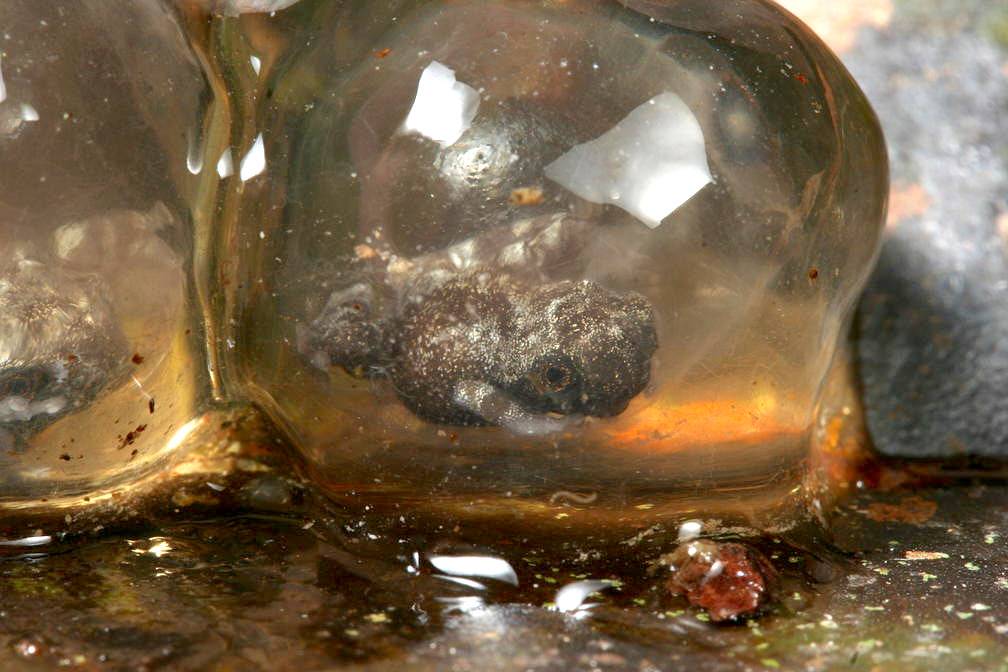
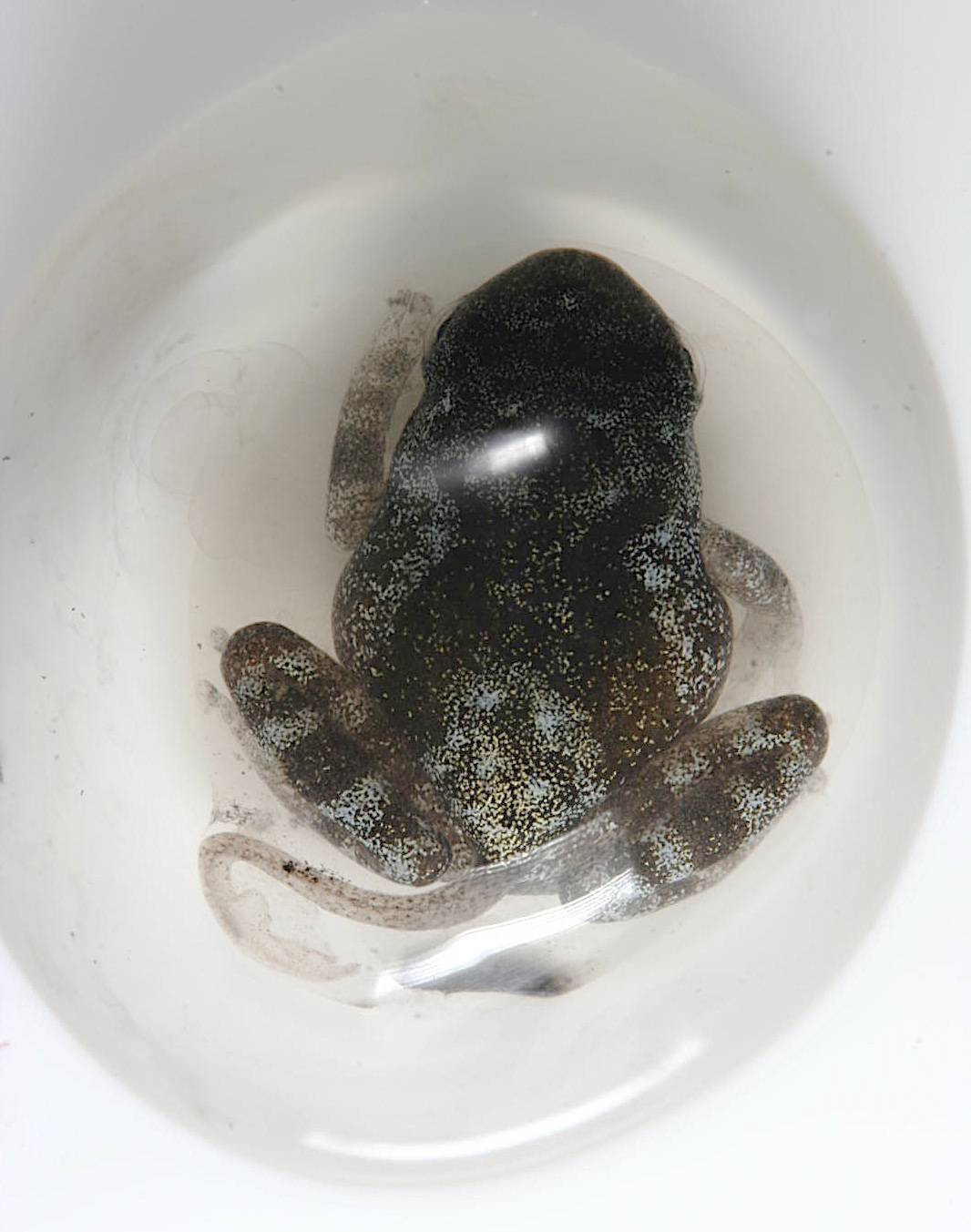
Three egg capsules were found incidentally on the forest floor within montane forest. One egg capsule was empty, the other two contained one froglet each. The eggs had been deposited between wet, rotting leaf litter, beneath a dead branch of a tree. The jelly capsules measured 13 mm in diameter.
Etter, L., Haas, A., Lee, C.C., Pui, Y.M., Das, I., Hertwig, S.T. (2021) Out of the trap: A new species of bush frog (Anura: Rhacophoridae: Philautus) from Borneo, with an updated phylogeny of Philautus. Journal Zoological Systematics Evolutionary Research 59: 1064–1096.

Hertwig, S.T., Lilje, K.E., MIN, P.Y., Haas, A., Das, I. (2012) Molecular evidence for direct development in the rhacophorid frog, Philautus acutus (Rhacophoridae, Anura) from Borneo. The Raffles Bulletin of Zoology 60: 559–567.

Malkmus, R., Dehling, J.M. (2008) Anuran amphibians of Borneo as phytotelm-breeders—a synopsis. Herpetozoa 20: 165–172.

Malkmus, R., Manthey, U., Vogel, G., Hoffmann, P., Kosuch, J. (2002) Amphibians & Reptiles of Mount Kinabalu (North Borneo). Koeltz Scientific Books, Königstein. 424 pp.