Frogs of Borneo

Frogs of Borneo

Frogs of Borneo

Frogs of Borneo

Frogs of Borneo

Frogs of Borneo

Frogs of Borneo

Frogs of Borneo

Frogs of Borneo

Frogs of Borneo

Frogs of Borneo
Filter
Pelobatrachus baluensis
A montane species recorded from the pristine forests of Gunung Kinabalu and Crocker Range, at approximately 1200–2000 m a.s.l. Tadpoles inhabit small streams with low flow velocity and nearly still sections. They are shy and stationary, quickly seeking shelter when exposed. Tadpoles filter-feed among leaf litter, plant debris, or near rocks. When feeding, they assume an upward-directed posture, with the oral disc spread at the water surface. The surface layer of water, loaded with small particles, is sucked into the mouth. Although they lack a specialized sucker, tadpoles can adhere to rocks with their gular region (ventral to the oral disc).
-
Family:Megophryidae
-
Genus:Pelobatrachus
-
Ecomorph:exotrophic, lotic, surface feeder
-
Waterbody Type:flowing
-
Water Column:surface|leaf litter
-
Feeding Type:feeding, surface feeding
-
Size:37 mm
-
Development:larva, tadpole
-
Adult:Pelobatrachus
Coloration
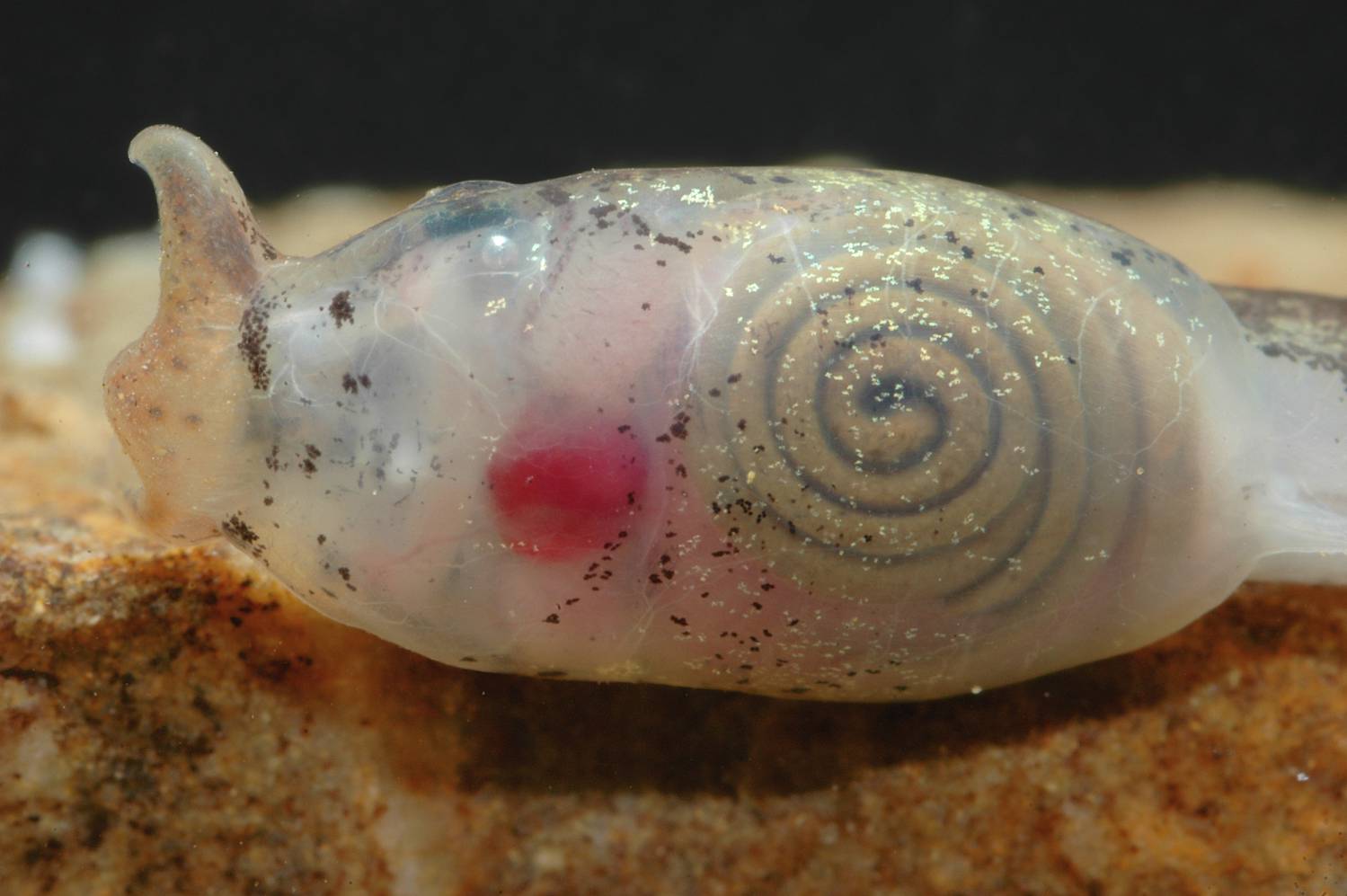
Dark brown above, with diffuse mottling of darker areas on a lighter brown background. Brass to golden iridophores scattered over dorsal surface and flanks of head and trunk; dense groups form a conspicuous accentuated light edge along the rising dorsal fin. Dense groups of melanocytes arranged as diffuse flecks along upper muscular part of tail, at base of anterior dorsal fin. Fins mottled and dark. Specimens become darker with development. Venter grayish semitransparent, sometimes with scattered iridophores in abdominal region. Gut coil visible. Heart and gills visible as red areas. Oral disc lightly pigmented, more so on dorsal lip; sometimes bears dark stripes dorsally and laterally. Submarginal papillae and ridges pigmented. Ventrally, a conspicuous black spot on each side at snout-oral disc transition. Oral disc often with orange tinge. Myosepta and lateral tail vein indistinct.
Snout
Smoothly narrowing toward base of oral funnel in lateral and dorsal view.
Oral Disc
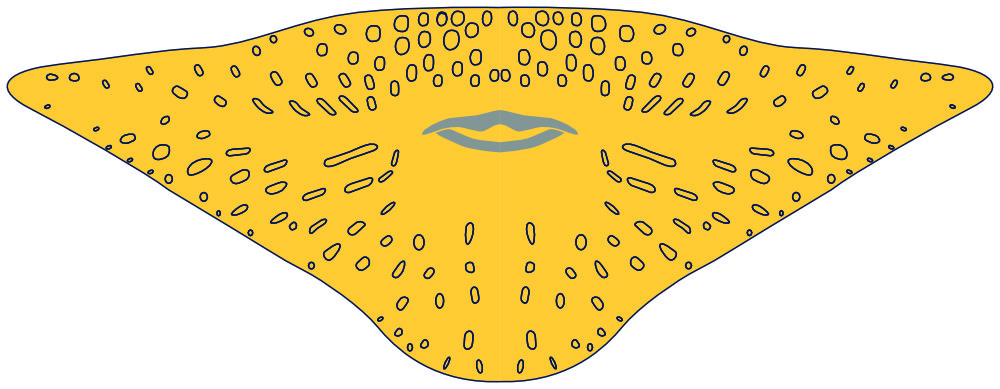
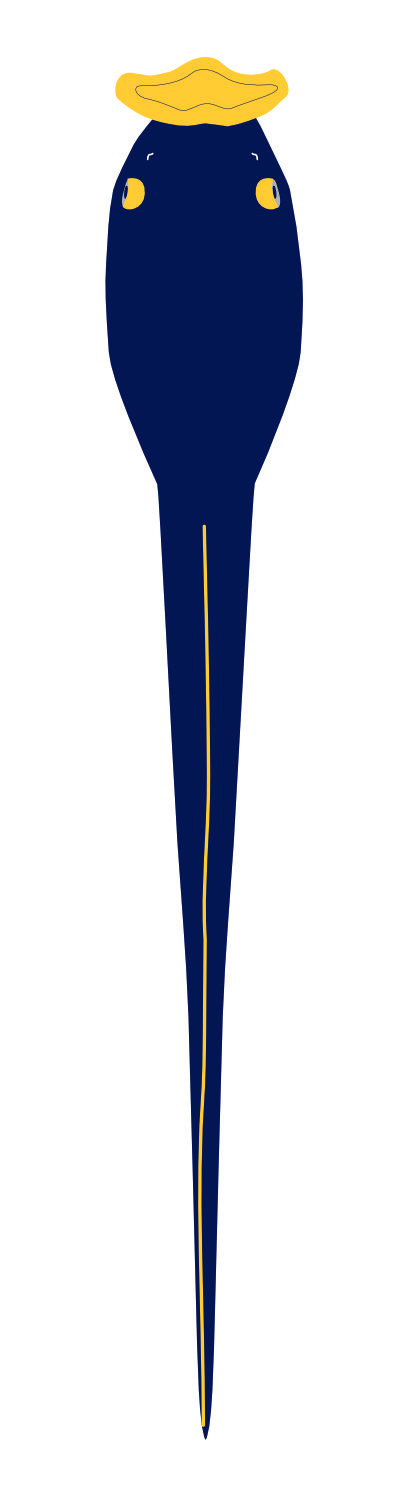
Terminal and turned upwards, umbelliform. Fully opened disc wider than body, pointed laterally. Lower lip sinuate, deeper than upper lip. Oral disc forms large rhomboid structure. In resting position, disc edges curled in and corners stand up like horns. When feeding at water surface, disc spreads. Marginal papillae absent. Oral disc bears numerous round and elongate submarginal papillae (ridges), arranged in rows and oriented toward mouth. Submarginal papillae particularly dense dorsal to mouth. Beaks deeply positioned in oral disc, hidden; thin, weakly keratinized. Upper beak sinuate with medial embayment; lower beak simple arch.
Body
Moderately large, slender. In lateral view, head and trunk only slightly depressed dorsoventrally. In dorsal view, body long, twice as long as wide, and more parallelsided than oval. Trunk clearly wider than base of the tail. Body widest at gill region. Spiracle sinistral; it opens posteriorly to posterolaterally, below the mid-body axis in lateral view. Spiracular orifice attached to body wall, no free tube. Lateral line organs indistinct.
Eyes & Nostrils
Eyes dorsolateral, widely spaced, cornea not protruding beyond body contour in dorsal view. Iris densely scattered with gold to copper iridophores on black background. Pupil slightly rhomboid. Peripheral sclera bears scattered gold or silver iridophores on black background. Nostril small, positioned in concavity of snout, slightly closer to eye than snout, oriented anterolaterally. Dorsal nostril rim with tiny triangular projection.
Tail
Long, up to 70% of total length (including funnel). Muscular part strong, almost as high as body in lateral view. Upper fin originates posterior to trunk-tail junction, rises in flat convex arch, then gradually descends to narrowly rounded tail tip. Lower fin starts at trunk-tail junction, slightly convex. Maximum tail and tail fin height at ~50% of tail length. Fins approximately equal in height. Skin glands absent.
Similar Species
Tadpoles of Pelobatrachus (and Sarawakiphrys dringi) are easily recognized by the uniquely upward directed oral disc. This feature is unique and renders misidentification with tadpoles from other Bornean genera unlikely. Within Pelobatrachus, however, reliable differential diagnoses of tadpoles have not been established. Auxiliary criteria such as geographic area and elevation may narrow the options. Features that have been described here and elsewhere need to be related to intraspecific variation before they can be used in interspecific diagnoses. Color patterns in megophryids can change considerable with growth of the larvae, further complicating field identification. Malkmus et al. (2002) presented a description and drawing of the very similar, sympatric tadpoles of P. kobayashii; however, reliable diagnostics remain unclear and more research on how to distinguish the two sympatric tadpoles is necessary. See S. dringi and P. nasutus for further information.
Literature
Details of reproduction are mostly unknown. Malkmus et al. (2002) recorded that males particularly call between 5:30–6:00 and 18:00–19:00 hrs from the banks of small streams.
Malkmus R, Manthey U, Vogel G, Hoffmann P, Kosuch J (2002) Amphibians & Reptiles of Mount Kinabalu (North Borneo). Koeltz Scientific Books, Königstein. 424 pp.