Frogs of Borneo

Frogs of Borneo

Frogs of Borneo

Frogs of Borneo

Frogs of Borneo

Frogs of Borneo

Frogs of Borneo

Frogs of Borneo

Frogs of Borneo

Frogs of Borneo

Frogs of Borneo
Filter
Meristogenys stenocephalus
The tadpoles live in clear, medium to large rocky lowland and hillside streams of western Sabah and northern Sarawak. They feed on organic rock overgrowth (algae, protists). We encountered these larvae at small cascades under openings in the canopy, in otherwise not very steep but rather broad streams.
-
Family:Ranidae
-
Genus:Meristogenys
-
Ecomorph:exotrophic, gastromyzophorous, lotic, rheophilous, suctorial
-
Waterbody Type:flowing
-
Water Column:rock surface
-
Feeding Type:feeding, hard surface grazer, omnivorous, rasping
-
Size:69 mm
-
Development:larva, tadpole
-
Adult:Meristogenys
Coloration
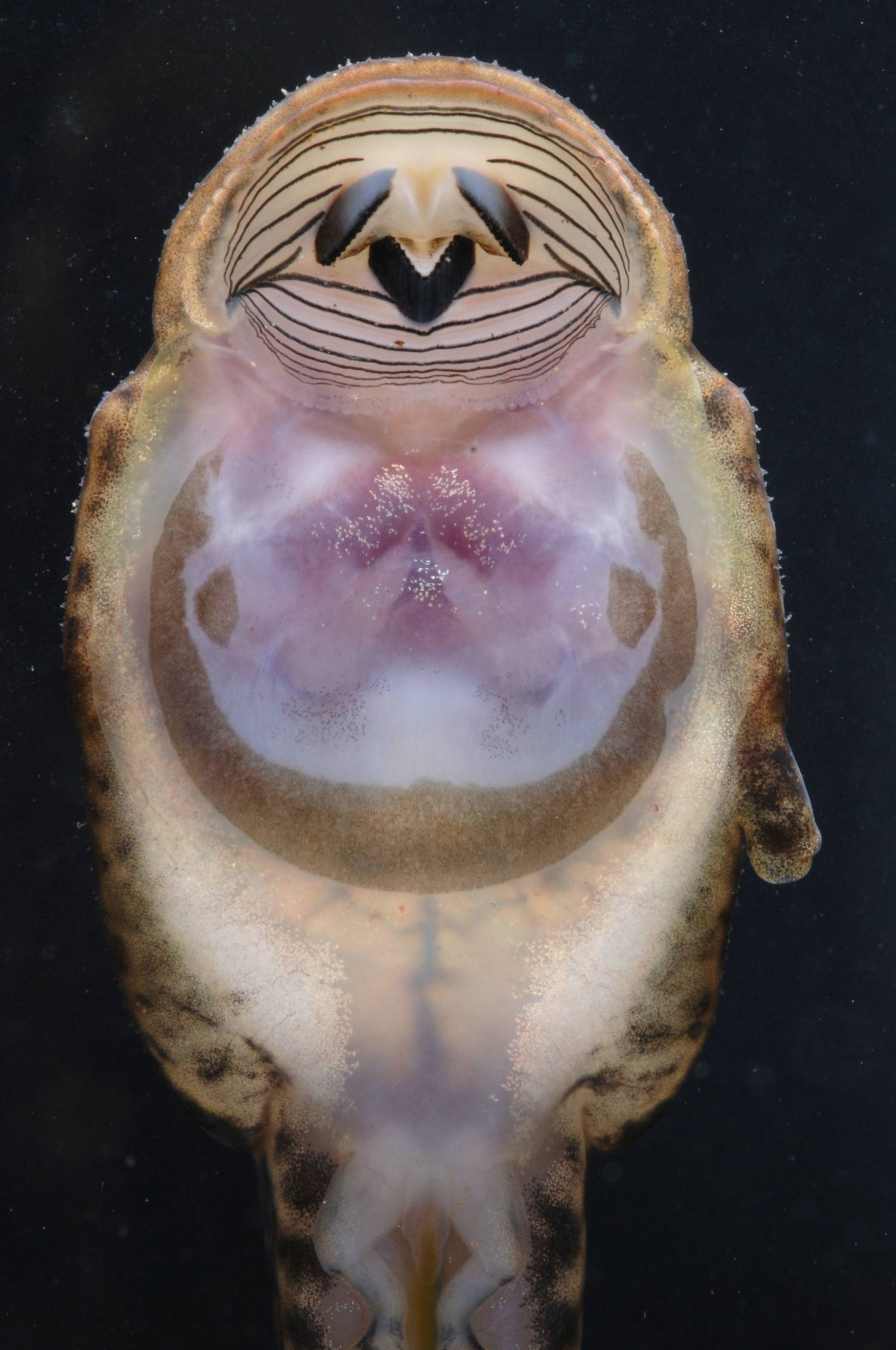
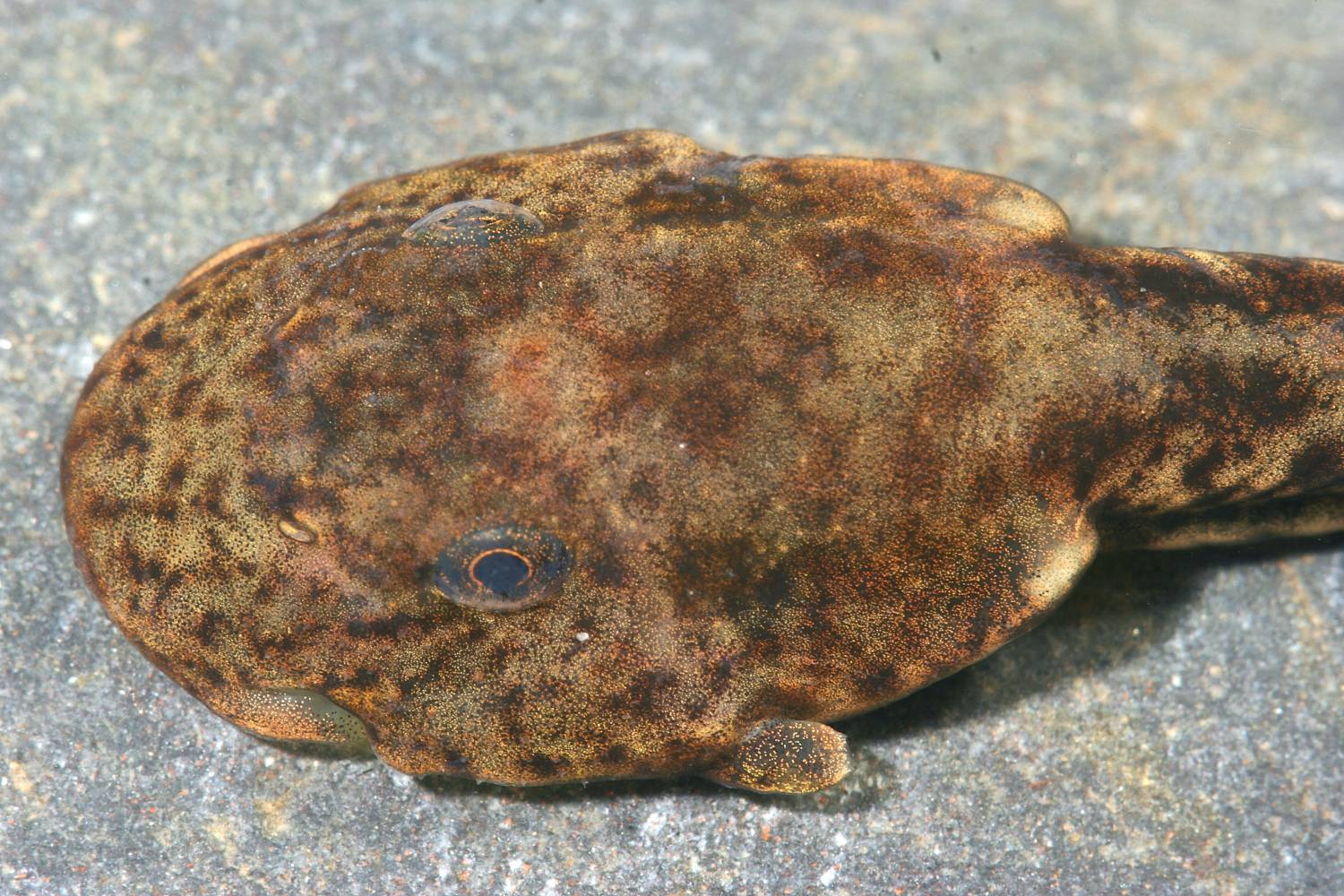
Mottled above with dark brown diffuse spots on a lighter brown background. This pattern extends onto the tail, where it shows higher contrast and larger spots. Light spots of iridocytes are present along the dorsal edge of the tail muscle and on the dorsal and lower fins. At the tip, they may form a bright stripe (occasionally also seen in other Meristogenys), sometimes with a bright orange hue in advanced tadpoles. Tail pigmentation is more intense in advanced than in early stages. In advanced stages, melanocytes along the blood vessels accentuate the proximal tail myosepta and produce a reticulate pattern on the tail fins. The oral disc and abdominal sucker are mostly unpigmented, except for their dorsal faces and rims. Gills and heart are not visible. The lateral sections of the abdomen are covered by dense whitesilvery iridocytes. The medial abdominal skin is unpigmented and semitransparent; the gut is hidden by pigmentation of the abdominal lining.
Snout
Broadly rounded in dorsal view. In lateral view, the snout is long and sloping, wedge-shaped, and only weakly convex. The oral disc is set off from the snout by a groove.
Oral Disc
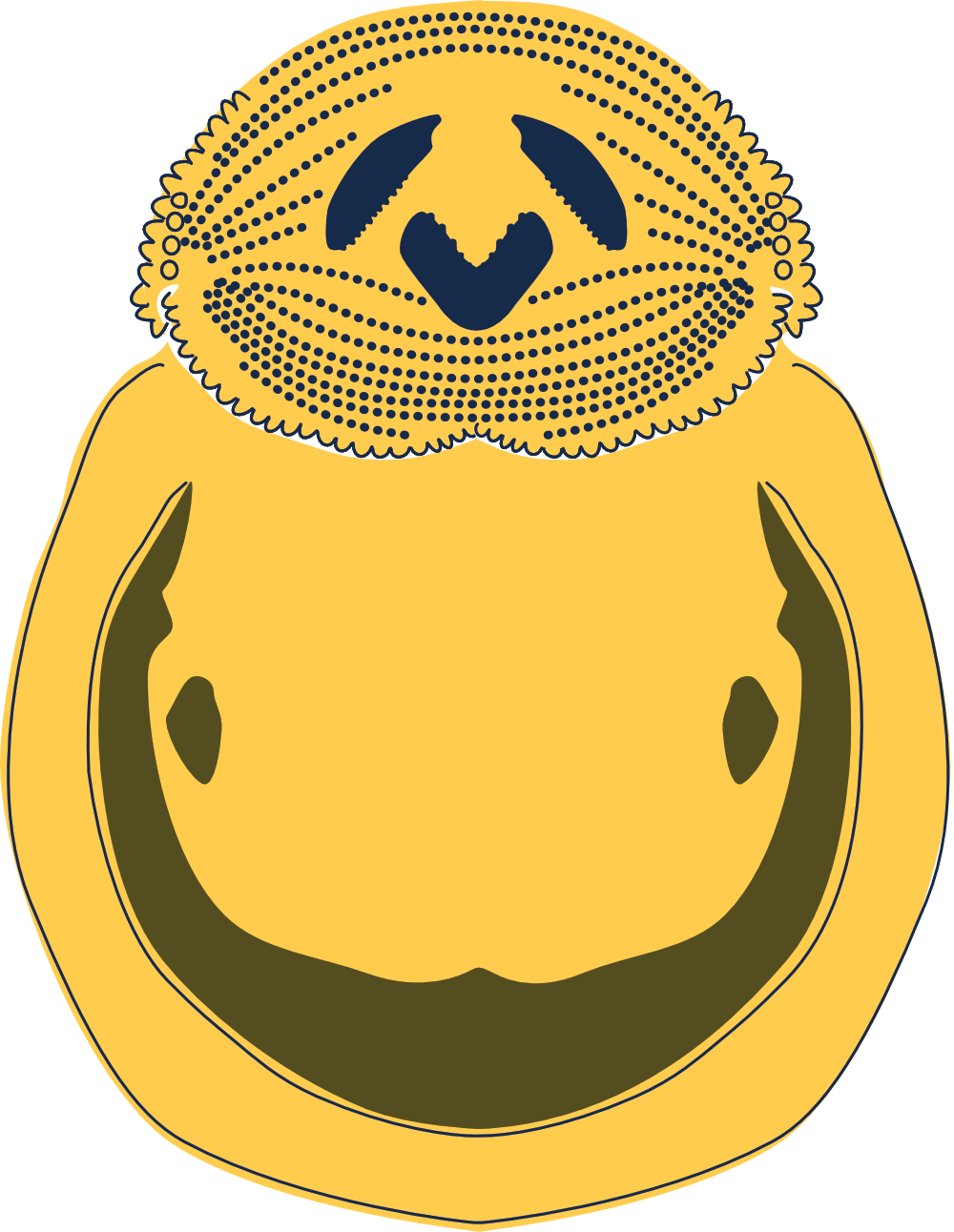
Ventral and wide. A large abdominal sucker is present posterior to the oral disc. The abdominal sucker is wide and thick-rimmed. The oral disc and sucker together cover approximately 80% of the body length. A broad brown horseshoe-shaped friction area is present inside the sucker rim; additionally, round friction areas are located laterally at the oral disc. Marginal papillation of the oral disc is present at the lower lip and at the lateral parts of the upper lip. Marginal papillae are short, rounded, and indistinct. A row of submarginal papillae is located at the lateral upper lip. LTRF 7(4–7)/7(1) to 7(4–7)/8(1). Beaks are strongly keratinized and deep black. The upper beak is widely divided. The lower beak is undivided and V-shaped. Beaks are smooth (unribbed); their edges bear serrations.
Body
Depressed and streamlined. In dorsal view, the body contour is oval to rectangular. A notch sets off the snout from the rest of the head. The posterior trunk end bulges posteriorly on both sides of the tail root. The body is widest at the level of the gills. The venter is flat. The spiracular tube is free and long, sinistral; the spiracle opens posteriorly and well below mid-body, close to the substrate in attached larvae. Skin glands may be difficult to see. Small groups of skin glands are located at the cheek, anterior to the spiracle, behind the eyes, and at the posterolateral bulge of the trunk; glands at the posterior end of the venter are absent. Lateral line organs are indistinct. Skin projections are present on the upper side of the body, densest on the snout and head, and scattered over the flanks.
Eyes & Nostrils
Nostrils are closer to the eyes than to the snout and oriented anterolaterally. Eyes are dorsolateral. The iris bears a thin ring of golden iridocytes around the pupil; otherwise, the iris is densely stippled with golden iridocytes on a black background. The sclera is stippled golden above and silver below.
Tail
Approximately 64–69% of total length. The muscular part of the tail is strong and high, as high as the body in lateral view. The dorsal fin starts posterior to the trunk-tail junction (10–13% of tail length). It rises straight to the highest point, then curves and slopes down in a convex line to the pointed tip. The lower fin originates at approximately 45% of tail length and is convex. The upper fin is much higher than the lower fin. Maximum tail height is at the midpoint of tail length. Skin glands are present along the base of the lower fin only.
Similar Species
Only species of Huia and Meristogenys possess larval abdominal suckers and are easily recognized by this feature. Meristogenys differs from Huia in the divided upper beak. Meristogenys stenocephalus shares seven upper lip keratodont rows (four divided), an undivided lower beak, skin projections, and a lack of dorsal fin glands with M. whiteheadi and M. stigmachilus; however, M. stenocephalus larvae appear to grow larger than those of the other two species. Reliable distinguishing characters have not yet been established, and DNA matching with adults is required.
Literature
No details have been reported for this species.
Shimada, T., Matsui, M., Nishikawa, K., Eto, K. (2015) A new species of Meristogenys (Anura: Ranidae) from Sarawak, Borneo. Zoological Science 32: 474–484. [with key to species]
Shimada, T., Matsui, M., Yambun, P., Sudin, A. (2011) A taxonomic study of Whitehead's torrent frog, Meristogenys whiteheadi, with descriptions of two new species (Amphibia: Ranidae). Zoological Journal of the Linnean Society, 161: 157–183.