Zum Hauptinhalt springen

Frogs of Borneo

Frogs of Borneo

Frogs of Borneo

Frogs of Borneo

Frogs of Borneo

Frogs of Borneo

Frogs of Borneo

Frogs of Borneo

Frogs of Borneo

Frogs of Borneo

Frogs of Borneo

Meristogenys penrissenensis

The tadpoles of Meristogenys penrissenensis live in the current of clear, midsized rocky streams on the hillsides of western Sarawak. Meristogenys penrissenensis tadpoles have been described from clear hillside streams of western Sarawak, where they are sympatric and even syntopic with M. jerboa. Their abdominal sucker allows them to hold on to rocks in the current. M. penrissenensis tadpoles graze on organic rock overgrowth (algae, small animals, bacteria), most actively during the night. They prefer moderate flow velocities. Groups of tadpoles may feed together on the same rock face, often associated with larvae of Ansonia.
  • Family:
    Ranidae
  • Genus:
    Meristogenys
  • Ecomorph:
    exotrophic, gastromyzophorous, lotic, rheophilous, suctorial
  • Waterbody Type:
    flowing
  • Water Column:
    rock surface
  • Feeding Type:
    feeding, hard surface grazer, omnivorous, rasping
  • Size:
    40 mm
  • Development:
    larva, tadpole
  • Adult:
    Meristogenys

Coloration

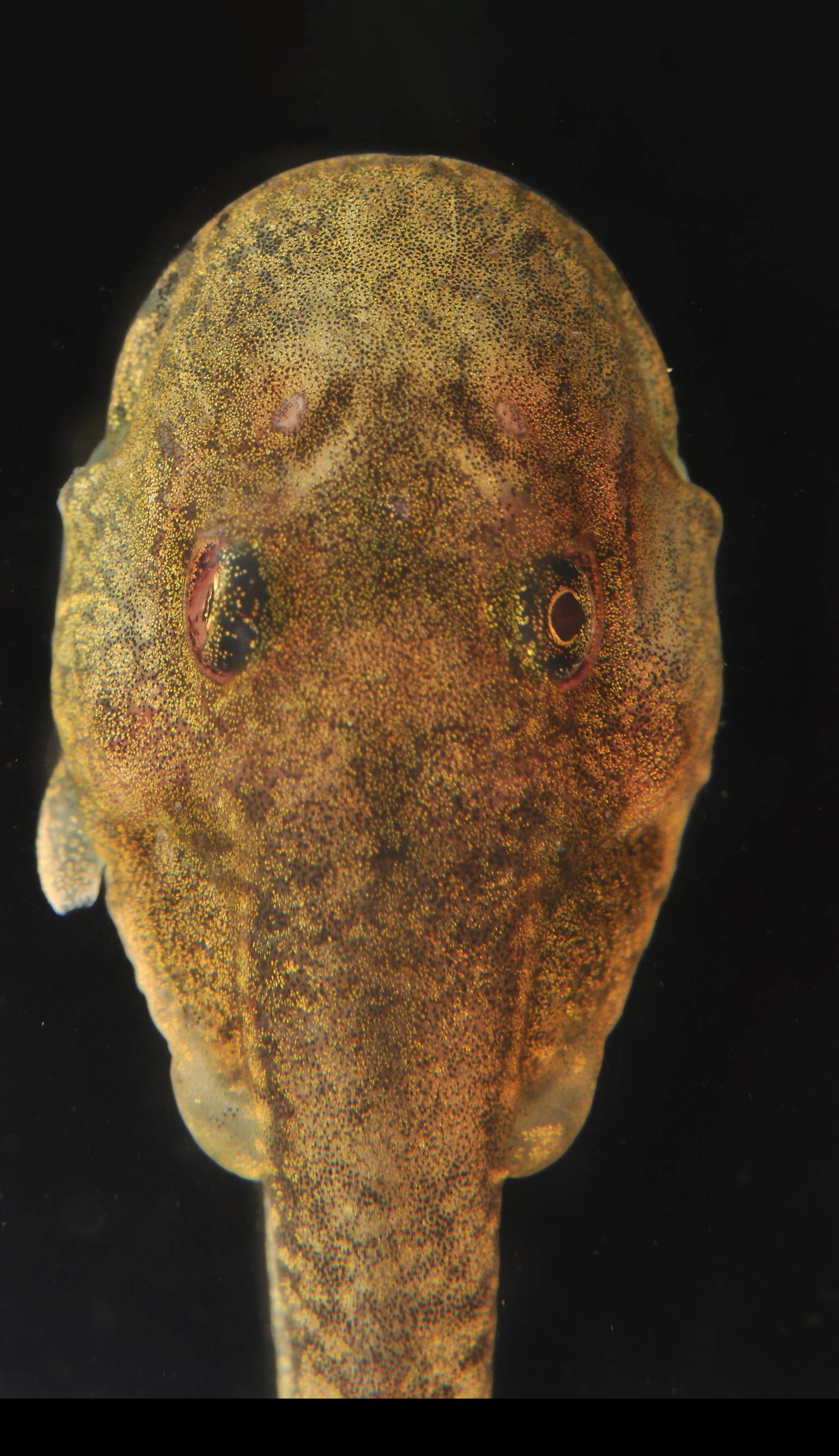
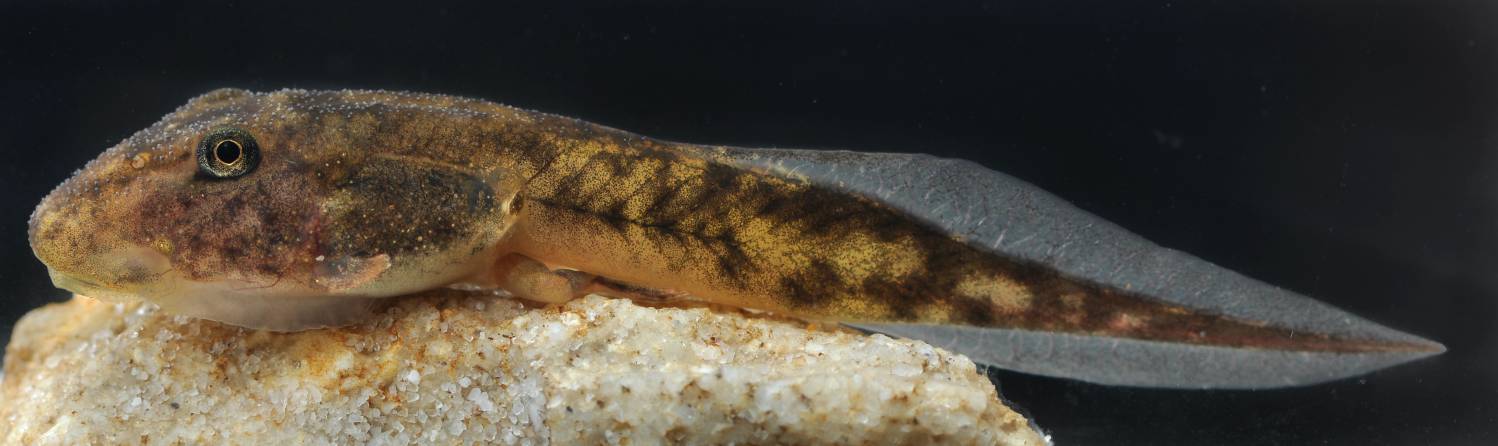
Dark brown irregular spots on a beige background give the tadpole a mottled appearance. The mottling becomes more blotchy and shows greater contrast on the tail. There is significant variation in the pattern, which is most pronounced in late-stage tadpoles. Iridophores are abundant over the body and muscular tail and can form light patches on the fins. The lateral abdomen is covered by a sheath of silver iridocytes; the medial abdominal skin is semitransparent; the gut is covered by deeper layers of pigmentation and not clearly visible. The oral disc and abdominal sucker are unpigmented; gills and heart are invisible. Specialized epithelium (friction areas) along the inner side of the sucker rim is visible as light brown areas. Tail fins may bear some diffuse dark and light blotches of pigmentation (melanocytes and iridocytes) along their margins. In advanced stages, melanocytes along the blood vessels accentuate the myosepta and can create a reticulate pattern on the tail fins.

Snout

Broadly rounded in dorsal view. In lateral view, the snout is long and sloping in a slightly convex curve. The oral disc is set off from the snout by a groove.

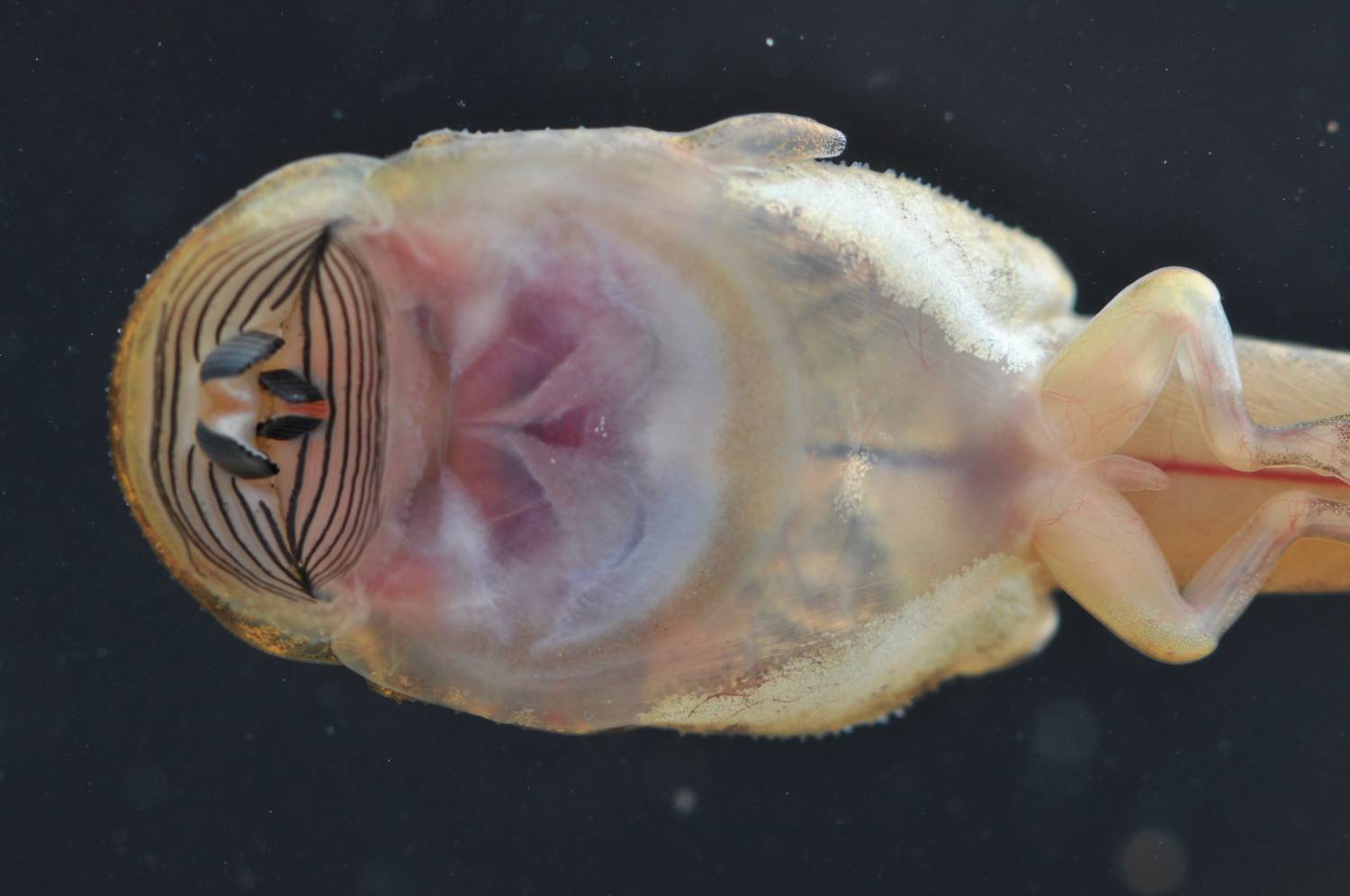
Oral Disc

Ventral and wide, followed posteriorly by a large abdominal sucker. The abdominal sucker is thick-rimmed and covers a large area ventrally.

Body

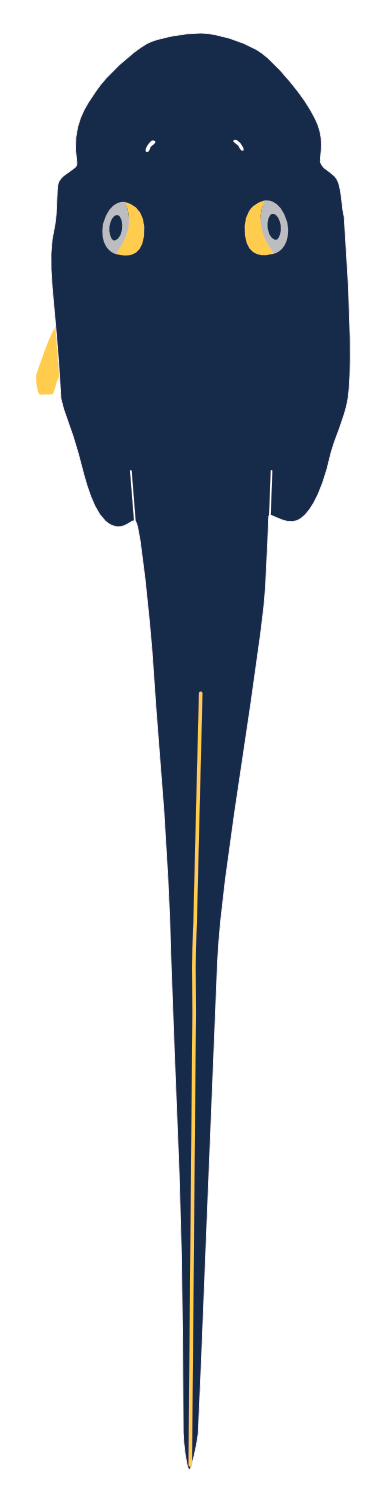
Depressed and streamlined in lateral view. Body contour oval to rectangular, the snout slightly set off by a notch. The trunk bulges posteriorly on both sides of the tail root. The body is widest at the level of the gill region. In lateral view, the trunk is just as deep as the head, i.e., the venter is flat. The spiracle is a free, long tube, sinistral, opening posteriorly well below mid-height of the body and close to the substrate when the tadpole is attached. Small groups of skin glands are located at the cheek, anterior to the spiracle, behind the eyes, and at the posterior bulge of the trunk (also see description of tail). Ventral glands at the posterior end of the abdomen are absent. Glands may be difficult to see. Lateral line organs are indistinct. The head and upper trunk bear dense, small, conical skin protuberances, also scattered along the flanks.

Eyes & Nostrils

Eyes dorsolateral. Nostrils closer to the eyes than to the snout, oriented anterolaterally. The iris is black with a thin ring of golden iridocytes around the pupil, peripherally dusted with golden iridocytes. The sclera is stippled with silvery iridocytes.

Tail

Approximately 64–68% of total length. The muscular part of the tail is strong and high, almost as high as the body in lateral view. The dorsal fin starts well posterior to the trunk-tail junction (approximately 15% of tail length). The upper fin rises in a straight line to the highest point, often changing direction fairly abruptly and sloping down in a straight or slightly concave line to the pointed tip. The lower fin originates at approximately 40% of tail length and is much lower than the upper fin. Maximum tail height is slightly anterior to the midpoint of the tail. The fins are devoid of skin glands, or only a few may be present in the lower fin.

Similar Species

Meristogenys penrissenensis tadpoles are distinguished from sympatric M. jerboa larvae (and several other Meristogenys larvae) by possessing seven (four divided) upper lip keratodont rows (six, four divided, in M. jerboa). Close examination of the lower beak, skin glands, tail fins, LTRF, and skin protuberances is necessary to exclude other Meristogenys. Ansonia tadpoles can occur in the same streams but are easily distinguished by their lack of an abdominal sucker.

Literature

Males commonly perch on low vegetation, clay embankments, roots or rocks along the steep river bank. The male call is an unpulsed, sharp, highpitched, whistle. Calls are emitted at seemingly random intervals of several minutes at times.
Shimada, T., Matsui, M., Nishikawa, K., Eto, K. (2015) A new species of Meristogenys (Anura: Ranidae) from Sarawak, Borneo. Zoological Science, 32: 474-484.