Zum Hauptinhalt springen

Frogs of Borneo

Frogs of Borneo

Frogs of Borneo

Frogs of Borneo

Frogs of Borneo

Frogs of Borneo

Frogs of Borneo

Frogs of Borneo

Frogs of Borneo

Frogs of Borneo

Frogs of Borneo

Limnonectes conspicillatus

Limnonectes conspicillatus tadpoles have so far only been recorded from quiet pools in small, sometimes intermittent streams. During the day they mostly hide under leaf litter and appear to forage primarily at night.
  • Family:
    Dicroglossidae
  • Genus:
    Limnonectes
  • Ecomorph:
    benthic, exotrophic, lotic
  • Waterbody Type:
    flowing
  • Water Column:
    bottom
  • Feeding Type:
    feeding, generalist
  • Size:
    50 mm
  • Development:
    larva, tadpole
  • Adult:
    Limnonectes

Coloration

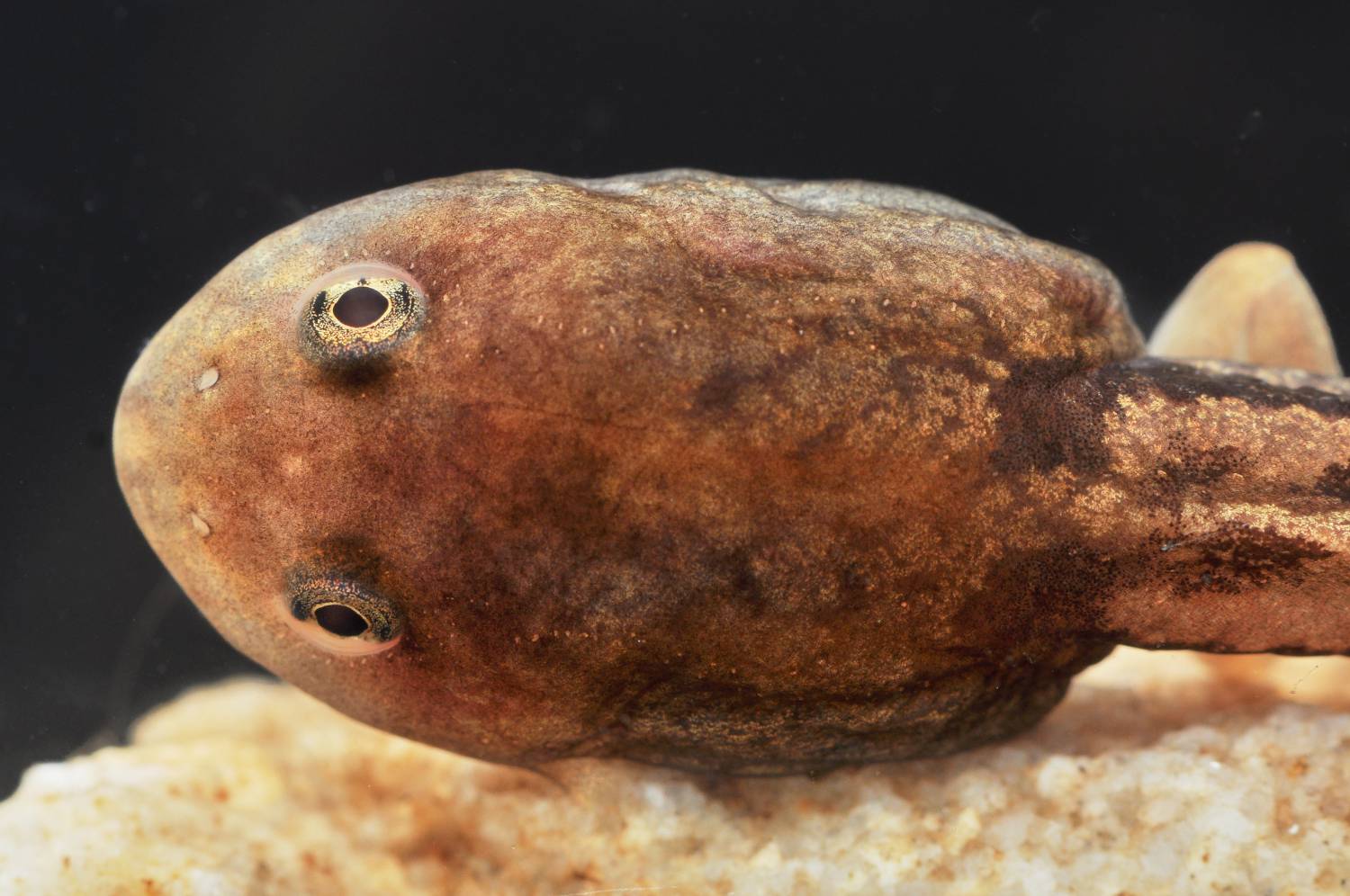
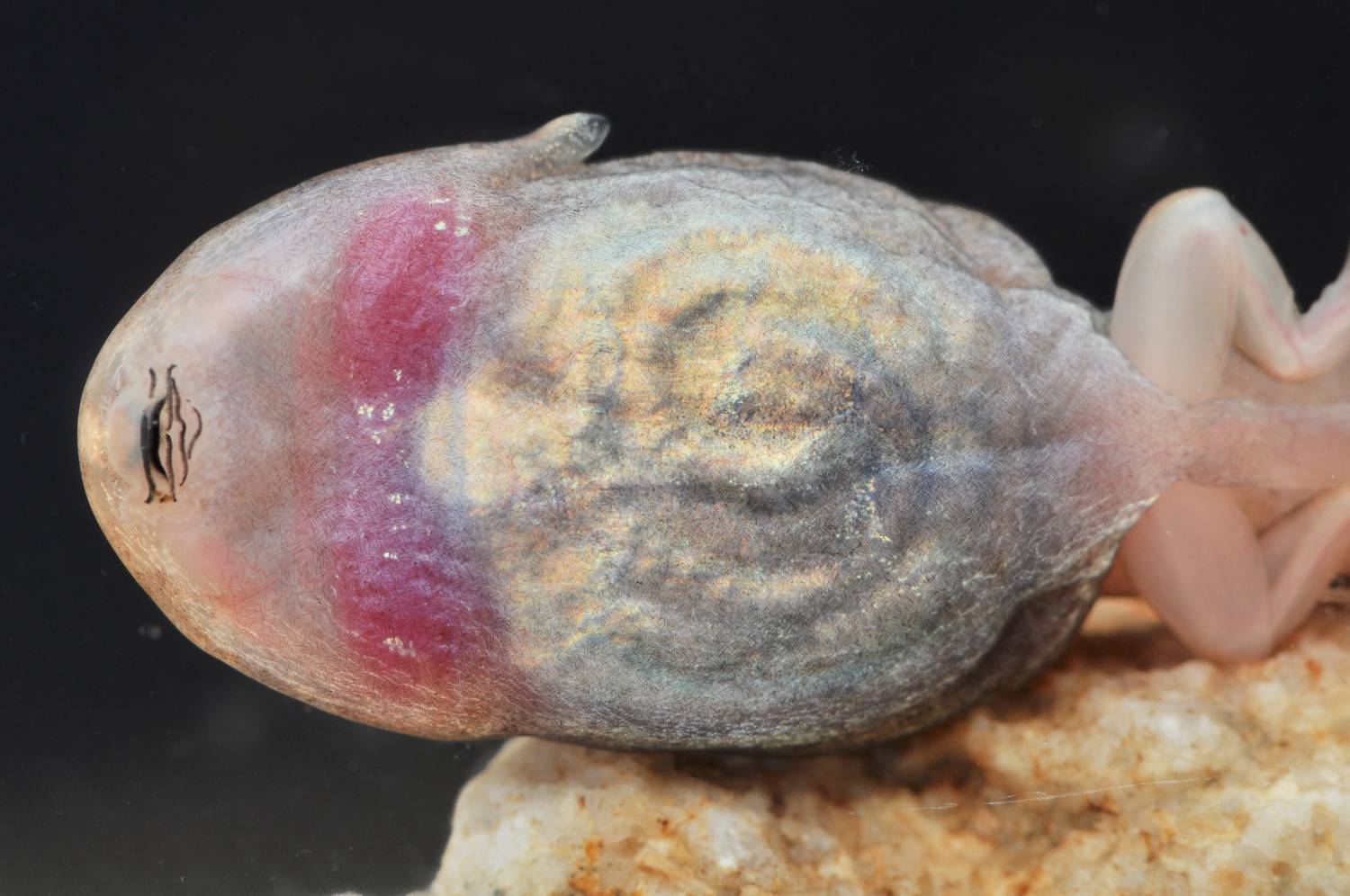
Generally brown to chocolate brown dorsally. On head and trunk, no well-defined pattern is present, rather diffuse lighter and darker areas occur. In lateral view, the lower face of the head and lower flanks appear more translucent, ranging from brown to gray, with dense horizontally oriented dashes of silver iridocytes. Ventral skin translucent, finely hatched with vermiculate melanocytes; red gills visible through the skin. Abdomen covered with a silver-gold sheet, median line absent; gut coil indistinct but visible in ventral and lateral views. Body background color continues onto the tail, with sharply defined dark blotches on the proximal muscular part of the tail and dorsal tail fin, less pronounced on the proximal lower fin. In the distal half of the tail, dark markings may fuse to form a large dark area. Other populations with less pronounced dark markings may indicate high variability. Tail and tail fins bear scattered patches of iridocytes.

Snout

Smooth and triangular in dorsal view; moderately long, blunt, and smoothly arched in lateral view. Oral disc does not project beyond the snout in dorsal view.

Oral Disc

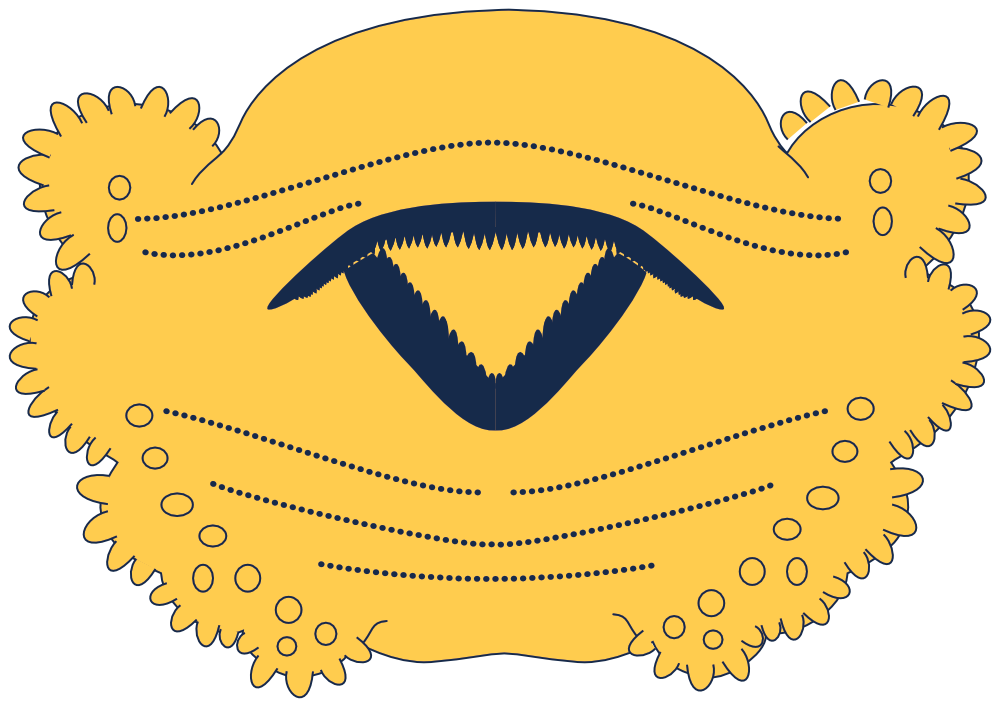
Ventral, moderately large (about a third of head width), not projecting beyond the snout contour. Clear emargination separates upper and lower lips; lower lip further segmented by one major and two minor indentations. Oral disc with blunt papillae along margins, except for a broad medial gap in the upper lip and a smaller but substantial medial gap in the lower lip. Submarginal papillae present on both lips, more numerous on the lower. LTRF 2(2)/3(1). Beaks moderately strong, well keratinized but not thick; edges bear fine serrations. Upper beak broadly and shallowly arched; lower beak V-shaped.

Body

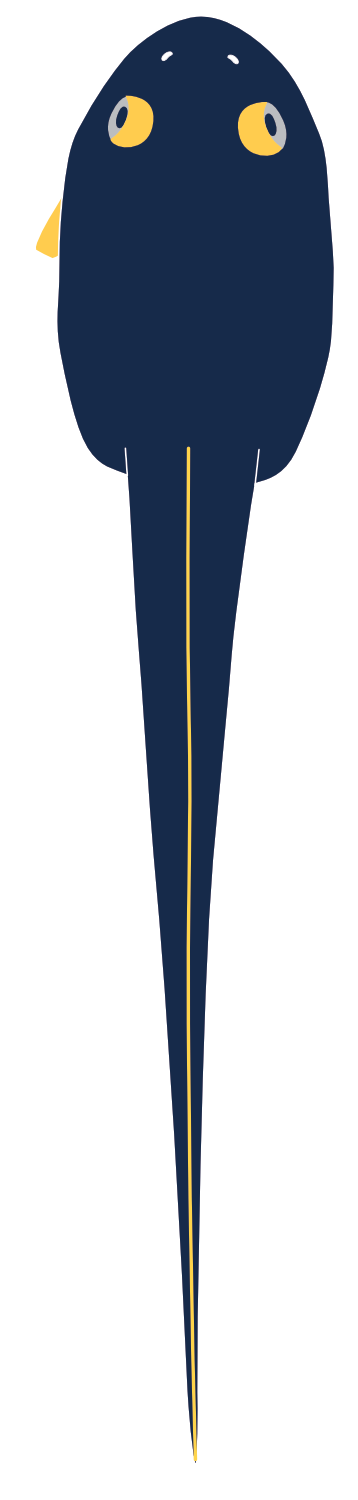
Medium to large, oval in dorsal view. Body dorsoventrally depressed. Head as wide as trunk. Widest point of body at gill region of head or trunk, depending on stage and feeding condition. Head weakly triangular in dorsal view. Spiracle sinistral, opening posteriorly. Medial rim of spiracular orifice free, forming a short tube; orifice located below mid-body in lateral view. Lateral line organs visible, particularly at head and along upper trunk.

Eyes & Nostrils

Eyes dorsolateral. Nostril relatively large, without projection, closer to snout than to eye, oriented anterolaterally. Iris with dense brass-to-gold iridocytes forming a complete ring around pupil; anterior and posterior sectors less dense and may appear darker.

Tail

Long, 68% of total length. Muscular part strong, distinctly higher than half body height in lateral view and more than half maximum trunk width in dorsal view. Upper fin starts at trunk-tail junction, reaching posterior trunk. Upper and lower fin contours similar and moderately arched. Upper fin higher than lower fin. Fins converge in posterior quarter with straight edges into a narrowly rounded tip. Maximum tail height at mid-tail. Lateral tail vein and tail myosepta indistinct.

Similar Species

The Creek Frogs were formerly represented by two species, L. kuhlii and L. laticeps, on Borneo. Recent studies synonymized these names and revealed multiple genetically distinct lineages. Numerous Creek Frog species may be described in the future. Morphological diagnosis of candidate species is not yet resolved. Tadpoles of all Creek Frog species are expected to be relatively similar in general shape, proportions, and snout shape. Considerable variation in coloration was found among populations (barred vs. blotched tail pattern, silver-white vs. clear abdomen). To resolve diversity and interspecific variation, further research on Creek Frogs and their larvae is needed. With experience, Creek Frog tadpoles can be distinguished from other Limnonectes species (such as River Frogs or Guardian Frogs) by a combination of body shape, fin shape, snout shape, and oral disc features.

Reproduction

No data available.

Literature

No data available.