Zum Hauptinhalt springen

Frogs of Borneo

Frogs of Borneo

Frogs of Borneo

Frogs of Borneo

Frogs of Borneo

Frogs of Borneo

Frogs of Borneo

Frogs of Borneo

Frogs of Borneo

Frogs of Borneo

Frogs of Borneo

Leptomantis cyanopunctatus

Little is known about the tadpoles of this species. So far, larvae have been reported from small forest streams not exceeding 2 m in width, where they occur in sections with moderate current and accumulations of leaf litter.
  • Family:
    Rhacophoridae
  • Genus:
    Leptomantis
  • Ecomorph:
    adherent, exotrophic, lotic
  • Waterbody Type:
    flowing
  • Water Column:
    bottom
  • Feeding Type:
    feeding, hard surface grazer, omnivorous, rasping
  • Size:
    28 mm
  • Development:
    larva, tadpole
  • Adult:
    Leptomantis

Coloration

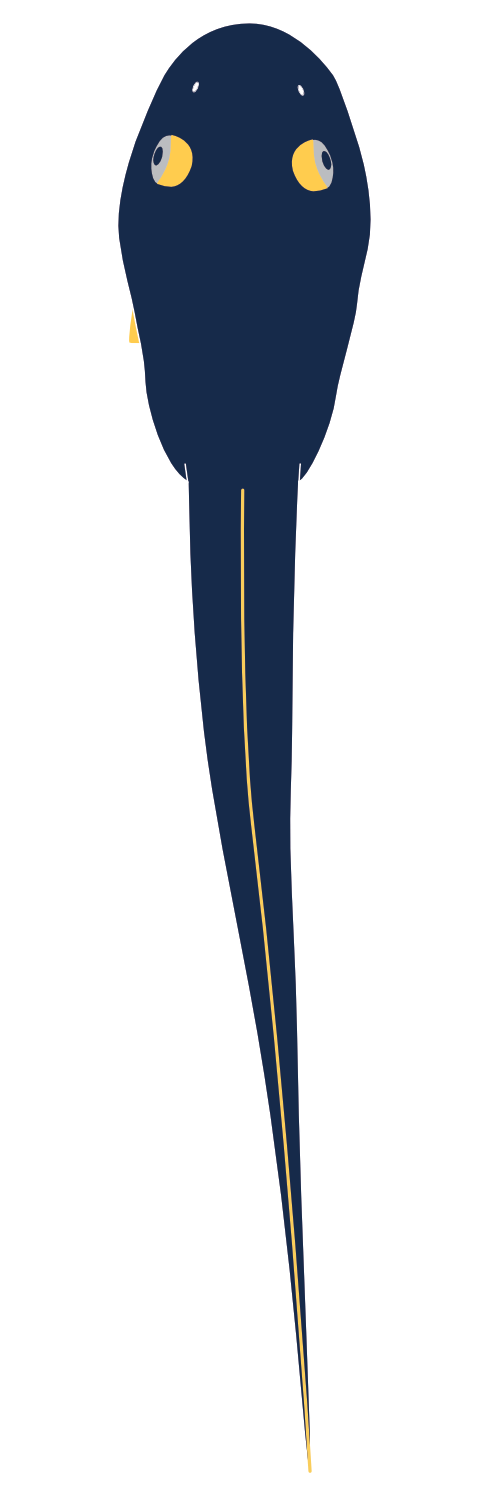
The general coloration of the body and tail is jet black. Body coloration extends onto the muscular part of the tail, whereas the tail fins are largely clear, except for narrow areas immediately adjacent to the dorsal and ventral margins of the tail musculature. The ventral side is light gray.

Snout

Rounded in dorsal view. In lateral view, the snout is relatively long, with a bluntly rounded profile.

Oral Disc

Ventral and cup-shaped, 57–62% of body width. Marginal papillae of the upper lip occupy the lateral thirds of the lip; the length of individual papillae increases from the inner toward the outer papillae. An additional inframarginal row is present in the lateral quarters of the upper lip. Marginal papillae of the lower lip are continuous, with two to three rows of evenly spaced inframarginal papillae. Nine keratodont rows are present on the upper lip and three on the lower lip in fully grown specimens (LTRF 9(5–9)/3(1)); earlier developmental stages have one fewer upper keratodont row. The margin of the upper jaw sheath is curved downward, whereas the lower jaw sheath is broadly arched. Both jaw sheaths are keratinized and serrated at their margins; keratinization of the lower jaw sheath is more extensive and wider than that of the upper jaw.

Body

Medium-sized. In lateral view, the body is slightly dorsoventrally depressed; in dorsal view, it is flat above. Body contour elliptical to smoothly rhomboid. Spiracle sinistral; spiracular tube opens posteriorly and is positioned well below the longitudinal body axis in lateral view. The medial part of the spiracular orifice is free from the abdominal wall, forming a short free tube visible from both dorsal and ventral aspects. The spiracle is located at 55–58% of body length. Lateral line pores are faintly discernible. Orbitonasal streak indistinct.

Eyes & Nostrils

Eyes positioned dorsolaterally. Nostril oval; in dorsal view, approximately equidistant between eye and snout, opening laterally.

Tail

Relatively long, approximately twice the body length. Muscular part strong. Dorsal fin weakly convex at mid-tail and slightly deeper than the lower fin. Tail fins taper gradually in the posterior third of the tail and terminate in a narrowly rounded tip.

Similar Species

The uniformly black body may cause confusion with tadpoles of Ansonia, which also inhabit stream environments. However, Leptomantis cyanopunctatus is easily distinguished from all species of Ansonia by the high number of keratodont rows on the upper lip (only two in Ansonia). Tadpoles of L. gauni and L. gadingensis may occur in the same streams but are lighter in coloration than L. cyanopunctatus.

Literature

Similar to other rhacophorid tree frogs, L. cyanopunctatus will likely be encountered in the vicinity of a suitable breeding habitat, in this case a stream, where adults perch on bordering vegetation. The clutch deposition has, to our knowledge, not been described, but the formation of a foam nest is likely in this species as in other species of Leptomantis.
Inger, R.F. (1985) Tadpoles of the forested regions of Borneo. Fieldiana Zoology new series 26: 1–89. [as Rhacophorus bimaculatus]

Leong, T.M. (2004) Larval descriptions of some poorly known tadpoles from Peninsular Malaysia (Amphibia: Anura). The Raffles Bulletin of Zoology 52: 609–620.