Zum Hauptinhalt springen

Frogs of Borneo

Frogs of Borneo

Frogs of Borneo

Frogs of Borneo

Frogs of Borneo

Frogs of Borneo

Frogs of Borneo

Frogs of Borneo

Frogs of Borneo

Frogs of Borneo

Frogs of Borneo

Leptobrachium abbotti

This species occurs in lowland to hill primary and secondary forests, up to approximately 1000 m a.s.l. Tadpoles prefer sections of gravel- or rock-bottom streams with low to moderate current, such as side pools, bays, stream margins, and shingle areas. They inhabit the bottom layers of the stream. At night, tadpoles can be observed in numbers grazing on bottom rocks and leaf debris or resting directly on the substratum. Mixed developmental stages are often present within the same stream, indicating extended breeding periods. During the day, tadpoles spend most of their time hidden in sheltered microhabitats and are much less conspicuous. Despite their large size, they are difficult to capture due to their alertness and rapid swimming behavior.
  • Family:
    Megophryidae
  • Genus:
    Leptobrachium
  • Ecomorph:
    benthic, exotrophic, lotic
  • Waterbody Type:
    flowing
  • Water Column:
    bottom
  • Feeding Type:
    feeding, generalist
  • Size:
    90 mm
  • Development:
    larva, tadpole
  • Adult:
    Leptobrachium

Coloration

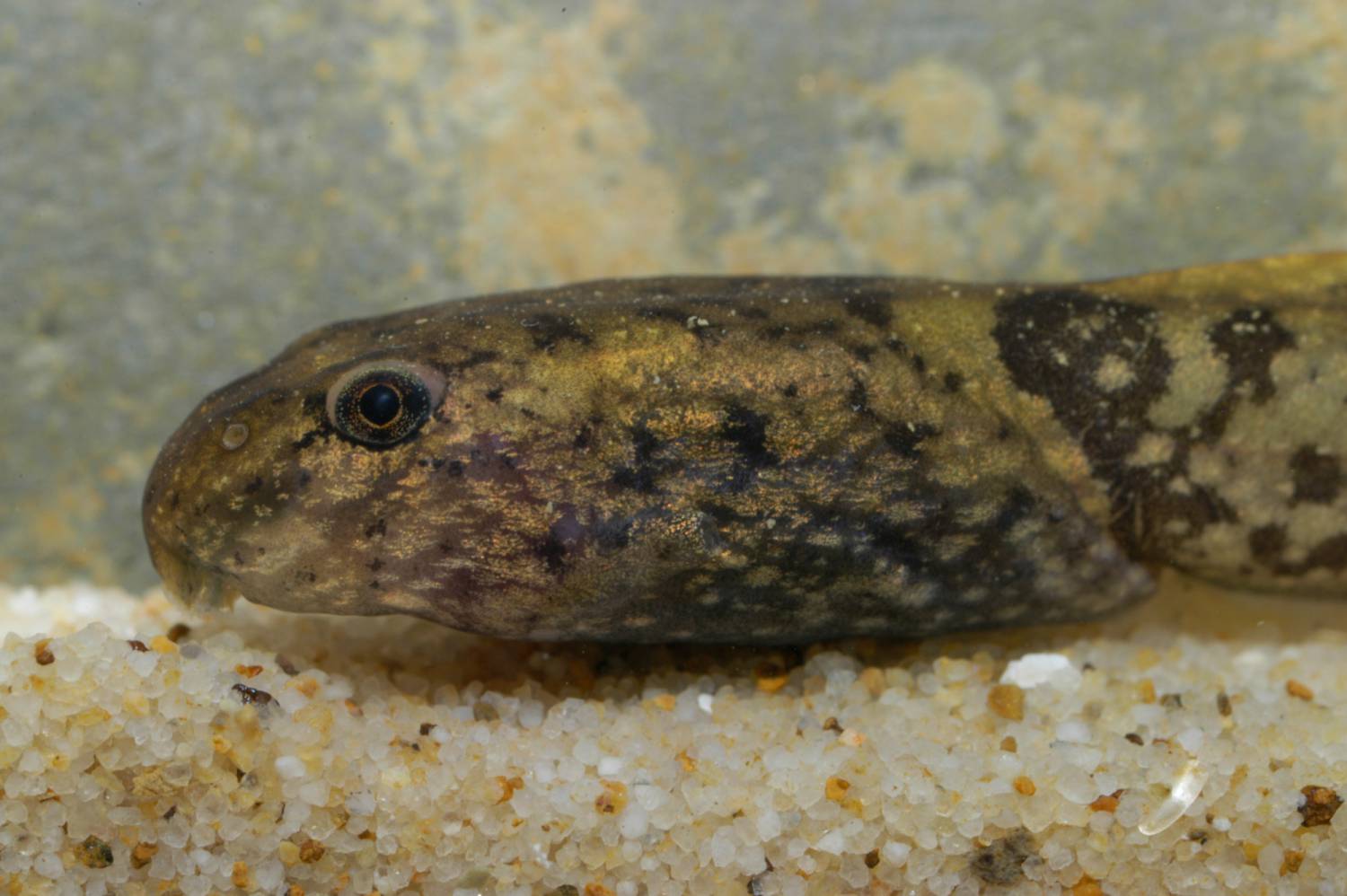
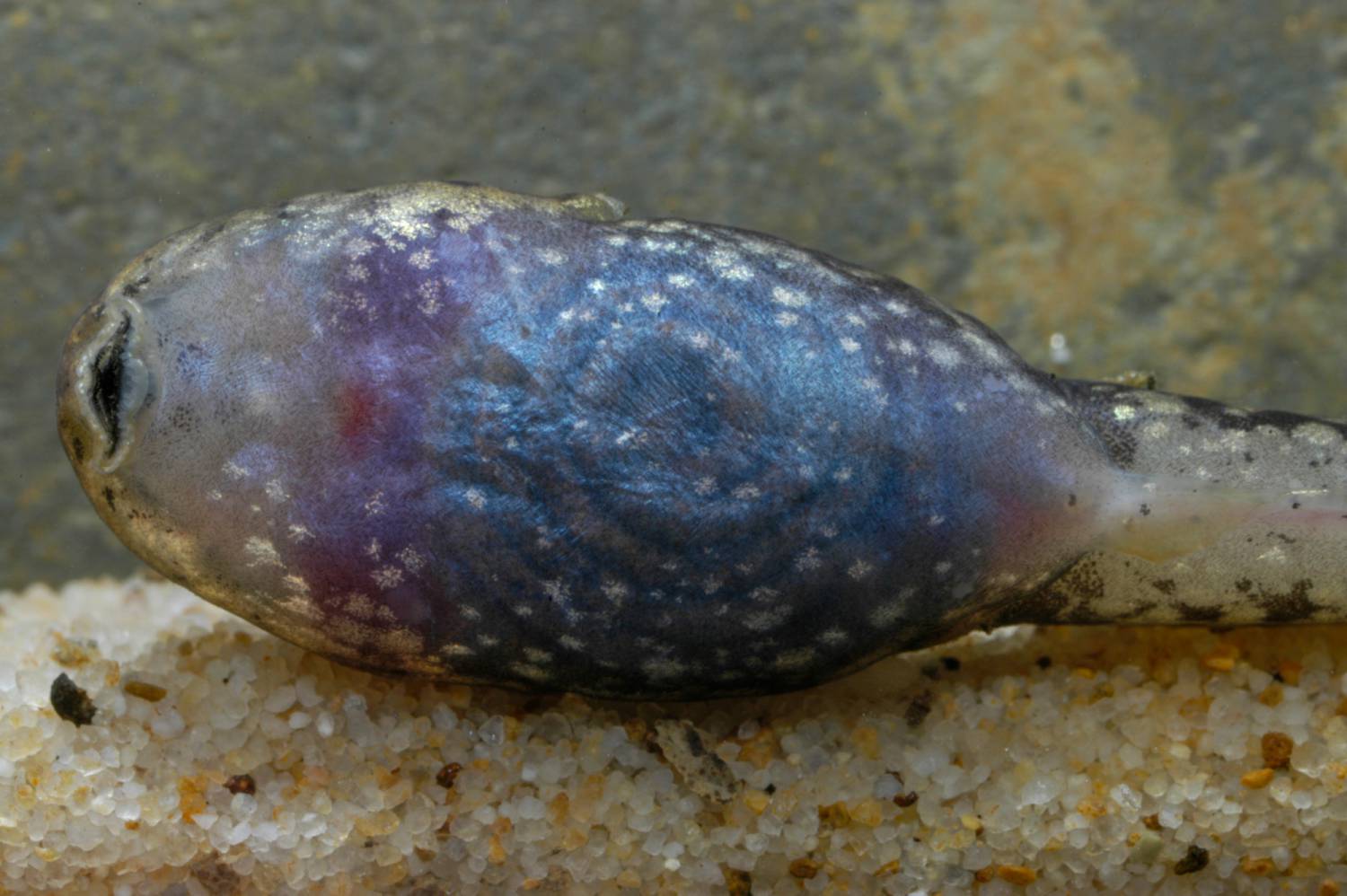
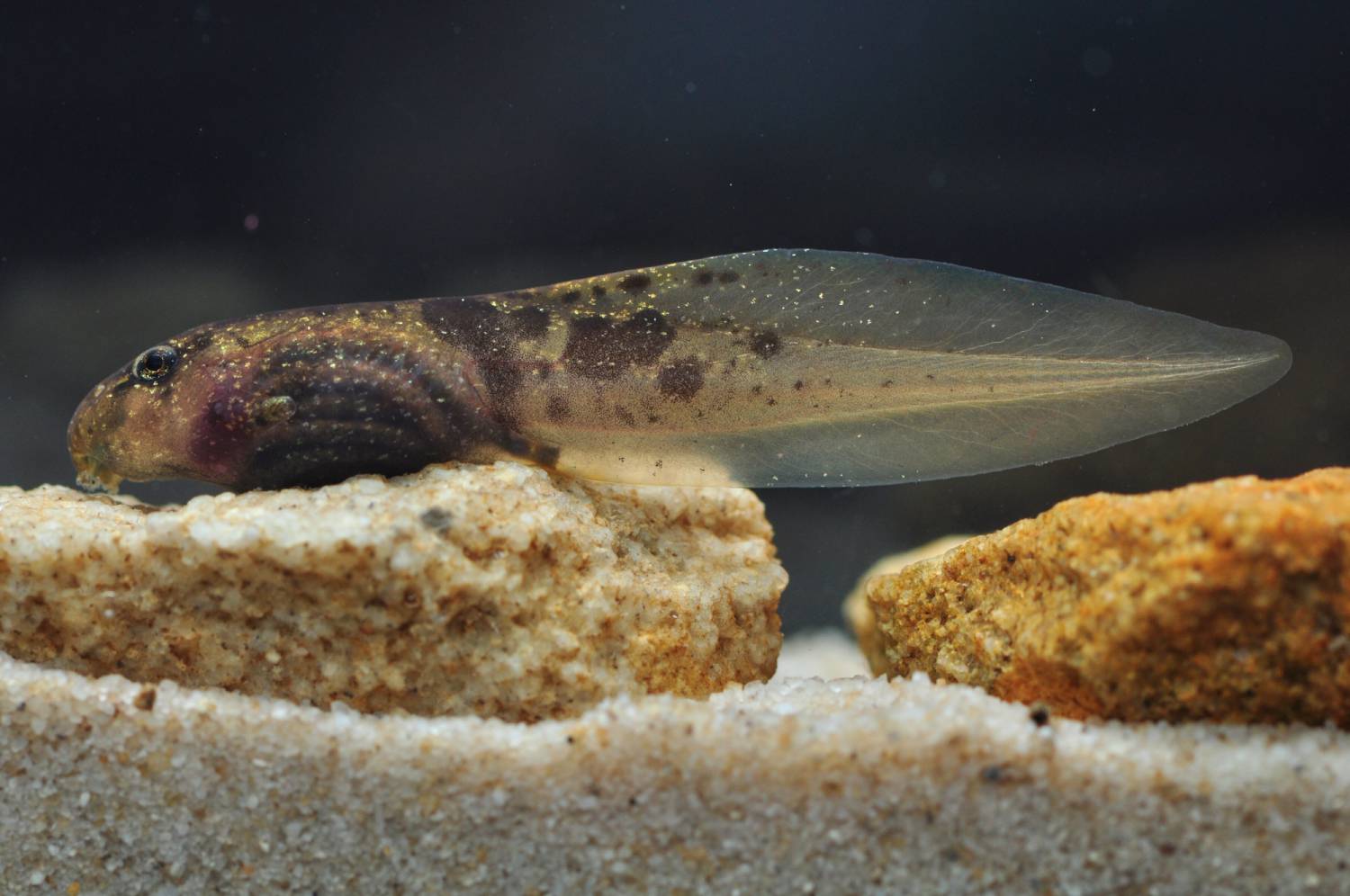
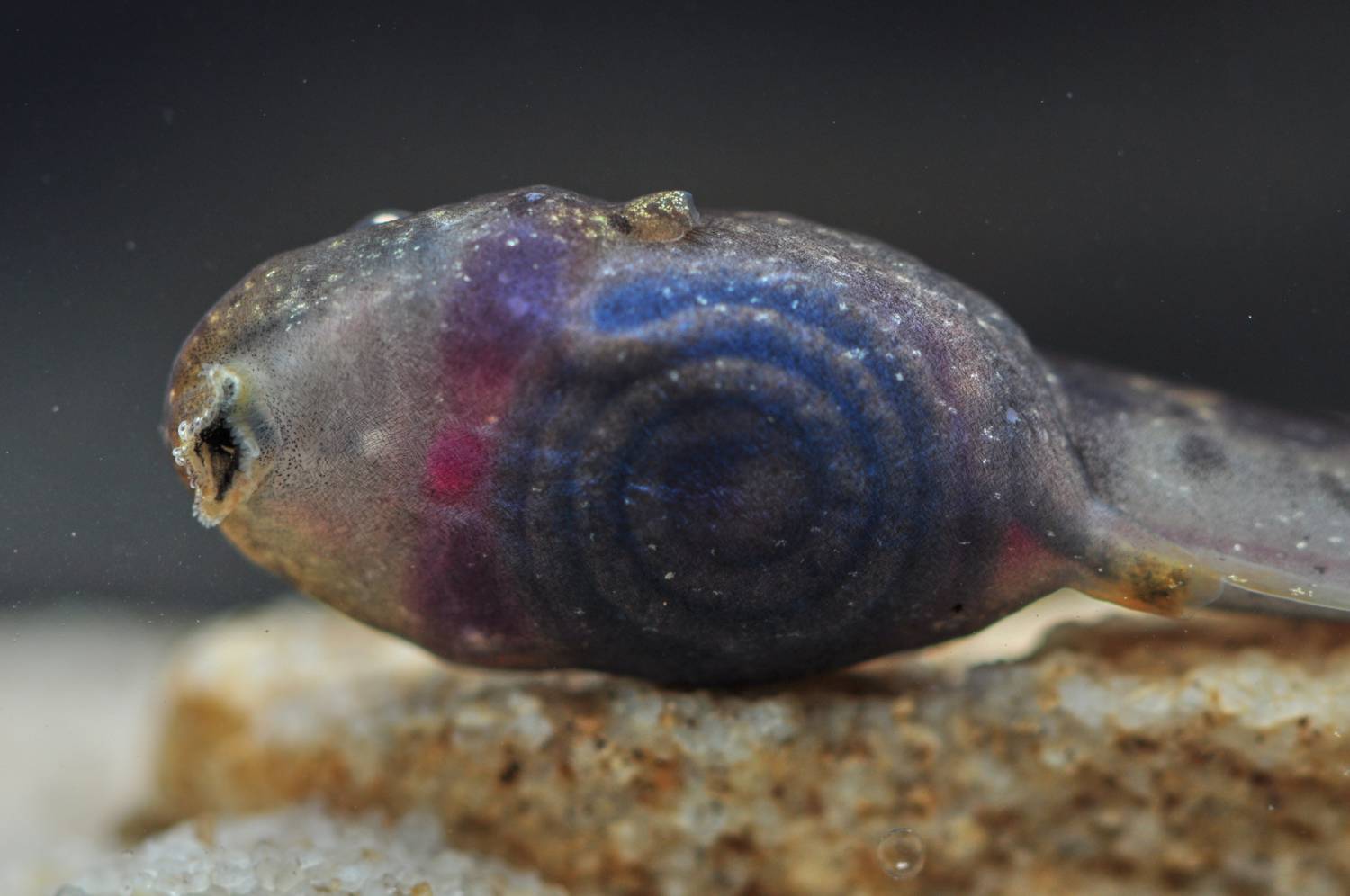
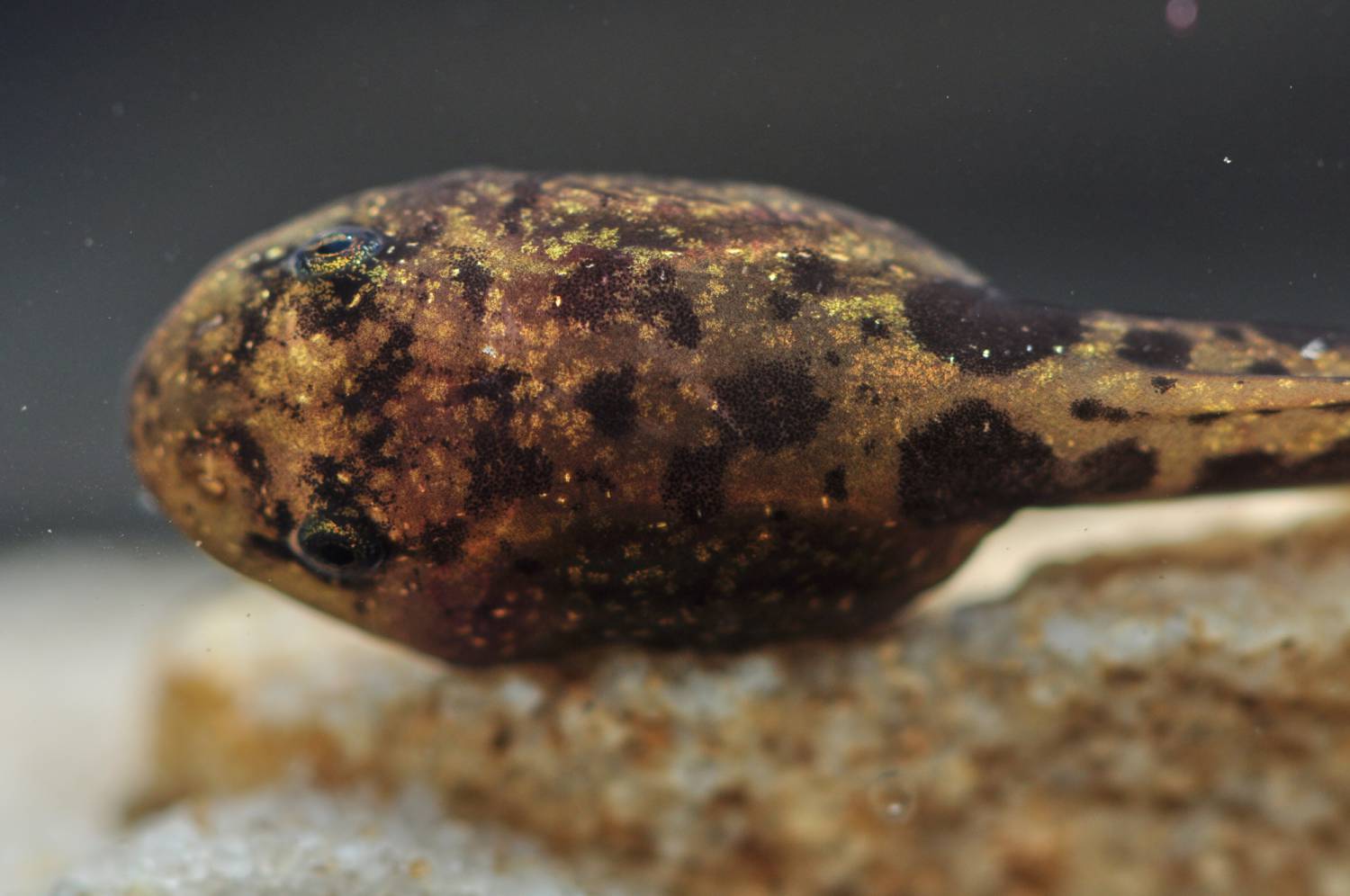
Coloration is variable, ranging from mottled to blotched. Tadpoles are generally dark brown dorsally, with darker markings on a slightly lighter background. Early developmental stages show overall lighter pigmentation. Individuals become progressively darker and more strongly mottled toward metamorphosis. Distinct dark blotches are present at the tail root, at least in early stages. Early stages also show a pair of whitish structures posterior to the head. Golden iridophores are arranged in patches dorsally and laterally and may also occur ventrally. In close-up view, a conspicuous hatched pattern of pigment cells is evident. The ventral side ranges from semitranslucent to opaque, depending on developmental stage. The gut coil is visible in early stages but becomes obscure in premetamorphic tadpoles, as do the heart and gills. In living specimens, the abdominal skin exhibits a bluish-silvery iridescence, which is absent in preserved material. Body coloration continues onto the muscular portion of the tail. In early stages, the tail pattern breaks up into blotches and spots distally, whereas in more advanced stages the mottling of the body continues seamlessly onto the tail. Myosepta and the lateral tail vein are indistinct.

Snout

The snout is broadly rounded, blunt, and moderately long in dorsal view. In lateral view, the head and snout curve smoothly downward, forming a rounded profile, with the region bearing the nostrils slightly bulging.

Oral Disc

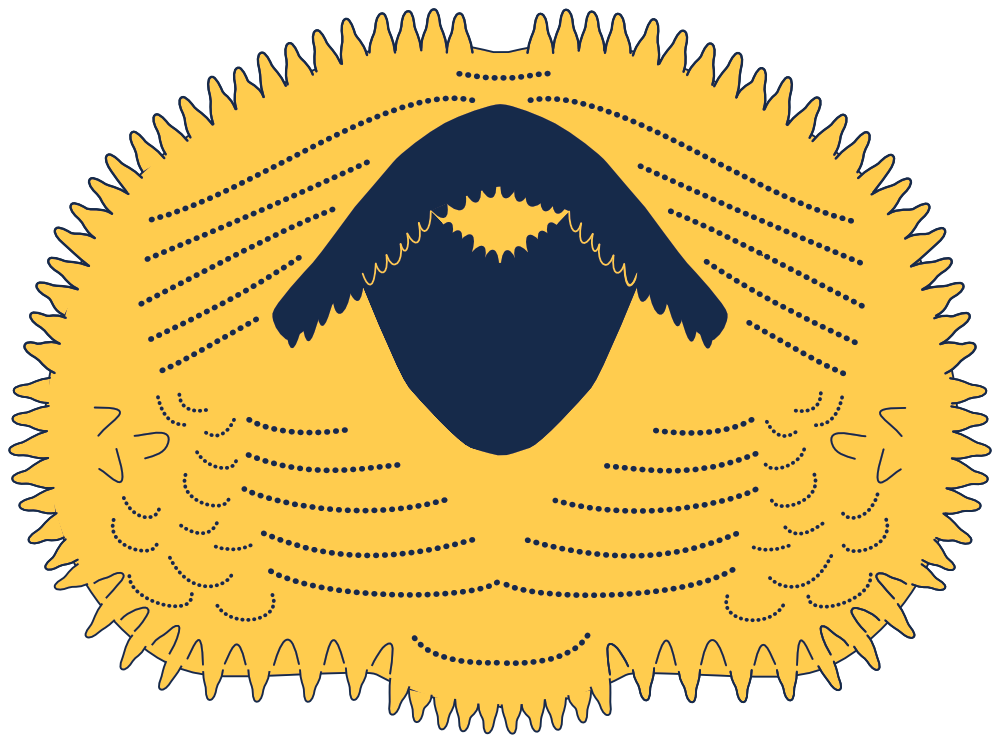
The oral disc is anteroventral to almost ventral in position and less than half the body width. Emarginations between the upper and lower lips are absent. Both lips bear conical marginal papillae arranged in a single row, with some stretches showing papillae in a staggered arrangement. Marginal papillation is nearly continuous, with a small medial gap in the upper lip. The keratodont formula is LTRF 6(2–6)/6(1–5) to 7(2–7)/6(1–5). The first upper and last lower keratodont rows are short. Laterally on the oral disc, submarginal papillae are present, along with up to 16 additional short submarginal ridges bearing short keratodont rows. The jaw sheaths are heavily built, strongly keratinized, deep black, and bear coarse serrations along their edges.

Body

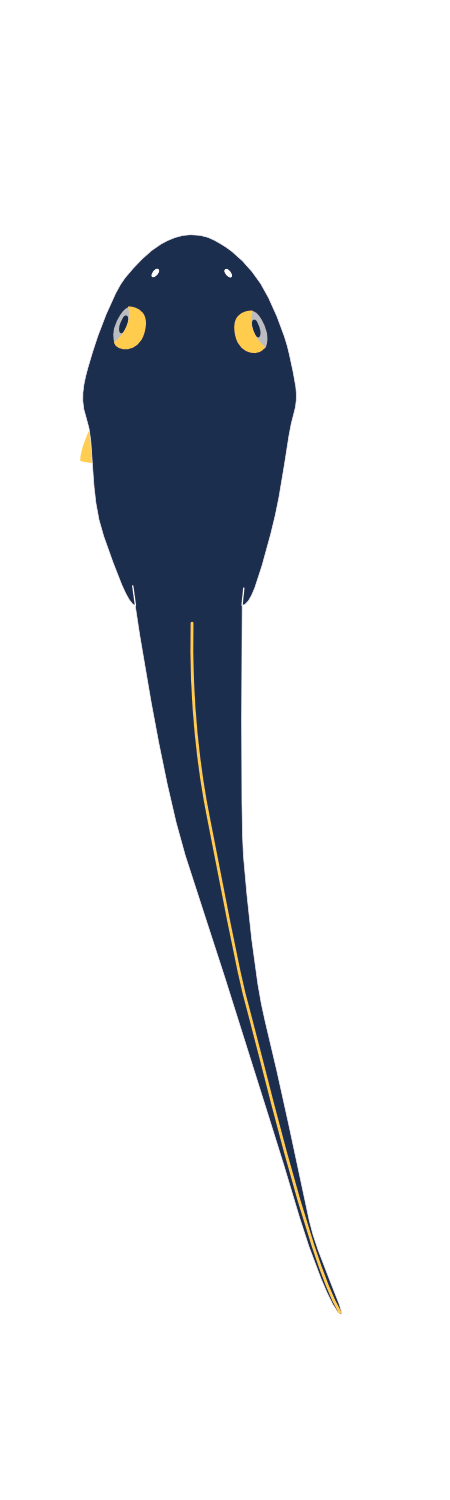
The body is large and robust, slightly dorsoventrally depressed. In dorsal view, the body outline is oblong-oval. The trunk is clearly wider than the base of the tail and reaches its maximum width at the anterior trunk or gill region, depending on feeding status. The spiracle is sinistral, opening posteriorly to posterolaterally. The spiracular opening is positioned slightly below mid-body level in lateral view, free from the body wall, and forms a short tube. Lateral line organs are distinct, forming broken lines of dash-like neuromasts on the head, along the flanks, and along the sides of the tail.

Eyes & Nostrils

The eyes are positioned dorsolaterally. The iris and scleral portion of the eye are black, densely scattered with iridophores that appear silver on the sclera and copper on the iris. The nostrils are distinct and relatively large, positioned slightly closer to the snout than to the eye and oriented anterolaterally. The dorsal rim of the nostril bears a soft, bulging projection.

Tail

The tail is long, measuring 66–68% of the total length. The muscular portion is strong and, in lateral view, nearly as high as the body. The upper fin rises gradually from the trunk-tail junction, ascending relatively straight to mid-tail, where it arches weakly before continuing almost straight to the narrowly rounded tip. The lower fin originates at the trunk-tail junction and is shallowly arched. Maximum tail-fin height is reached at approximately mid-tail. The upper fin is higher than the lower fin. Skin glands are absent.

Similar Species

Tadpoles of Leptobrachium are readily diagnosable at the genus level based on their habitat (rocky or gravel-bed streams), generally dark to black coloration, large size, and distinctive oral disc features. However, reliable interspecific diagnostic characters within Leptobrachium remain poorly established. Leptobrachium abbotti appears to differ from congeners by (1) possessing the densest and most pronounced hatched pigmentation pattern, which even covers the ventral skin, and (2) having higher numbers of additional lateral submarginal keratodont rows than L. montanum and L. gunungense. Leptobrachium ingeri has uniformly blackish tadpoles (the tadpole of the closely related L. kanowitense remains unknown). Tadpoles of the Creek Frog complex may occur syntopically and could be superficially confused with L. abbotti, but they never reach comparable size, are generally lighter in coloration, and differ in oral disc papillation patterns.

Literature

Males call from leaf litter at varying distance from the stream banks and neighboring forests. The loud call consists of 1–3 „quack“ notes.
Inger, R.F. (1983) Larvae of Southeast Asian species of Leptobrachium and Leptobrachella (Anura: Pelobatidae), pp. 1332. In Rhodin, A., and K. Miyata (eds.). Advances in Herpetology and Evolutionary Biology. Museum of Comparative Zoology, Cambridge, Mass.

Inger, R.F. (1985) Tadpoles of the forested regions of Borneo. Fieldiana Zoology new series 26: 1–89.

Malkmus R, Manthey U, Vogel G, Hoffmann P, Kosuch J (2002) Amphibians & Reptiles of Mount Kinabalu (North Borneo). Koeltz Scientific Books, Königstein. 424 pp.