Frogs of Borneo

Frogs of Borneo

Frogs of Borneo

Frogs of Borneo

Frogs of Borneo

Frogs of Borneo

Frogs of Borneo

Frogs of Borneo

Frogs of Borneo

Frogs of Borneo

Frogs of Borneo
Filter
Leptobrachella fritinniens
The tadpoles reported here were collected at Poring, Kinabalu Park, and Crocker Range National Park, from lower elevations of these mountain ranges. Tadpoles inhabit interstitial spaces in gravel beds of clear mountain streams.
-
Family:Megophryidae
-
Genus:Leptobrachella
-
Ecomorph:exotrophic, fossorial, gravel-interstice specialist, lotic
-
Waterbody Type:flowing
-
Water Column:fossorial
-
Feeding Type:feeding, generalist, leaf litter
-
Size:? mm
-
Development:larva, tadpole
-
Adult:Leptobrachella
Coloration
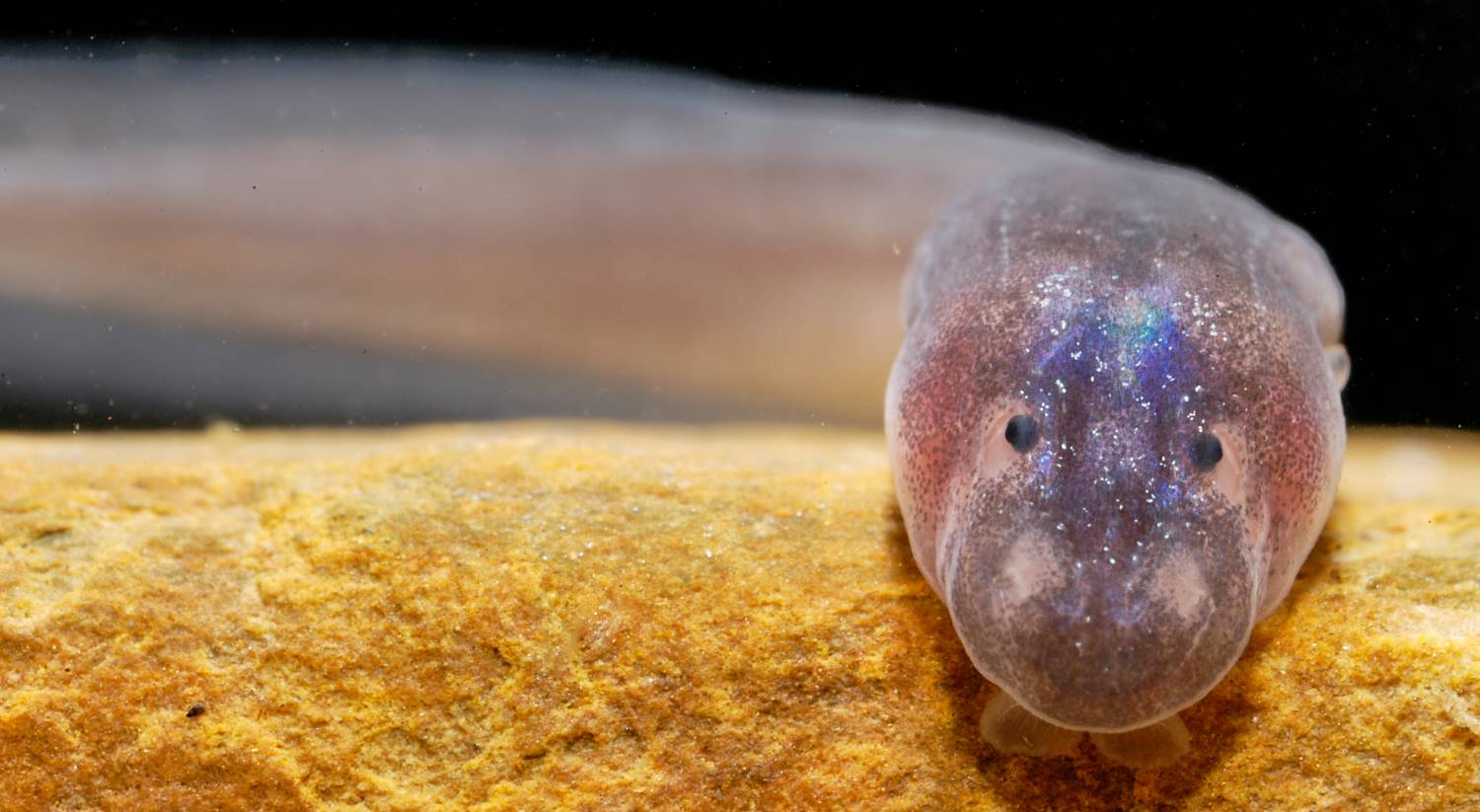
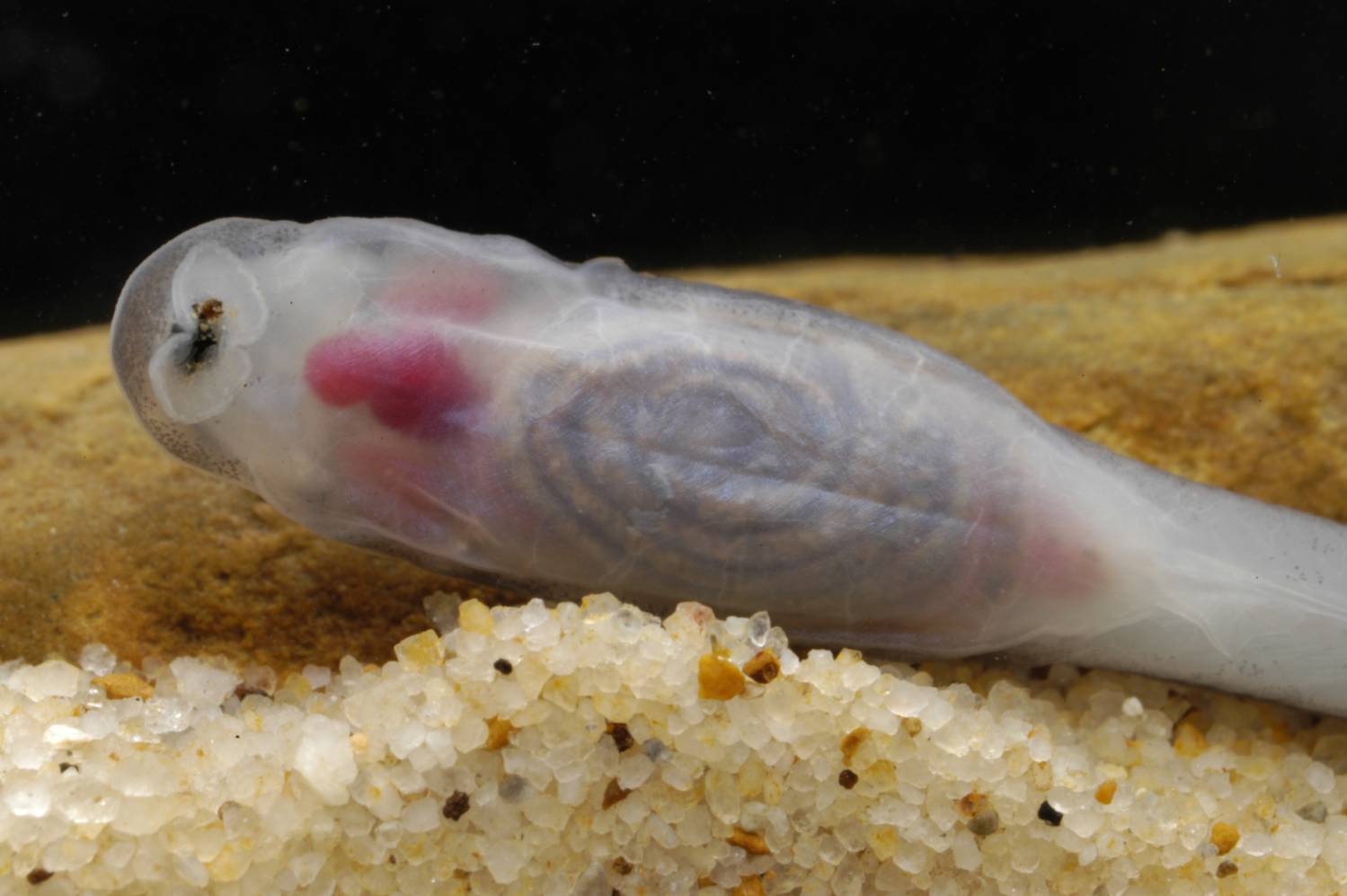
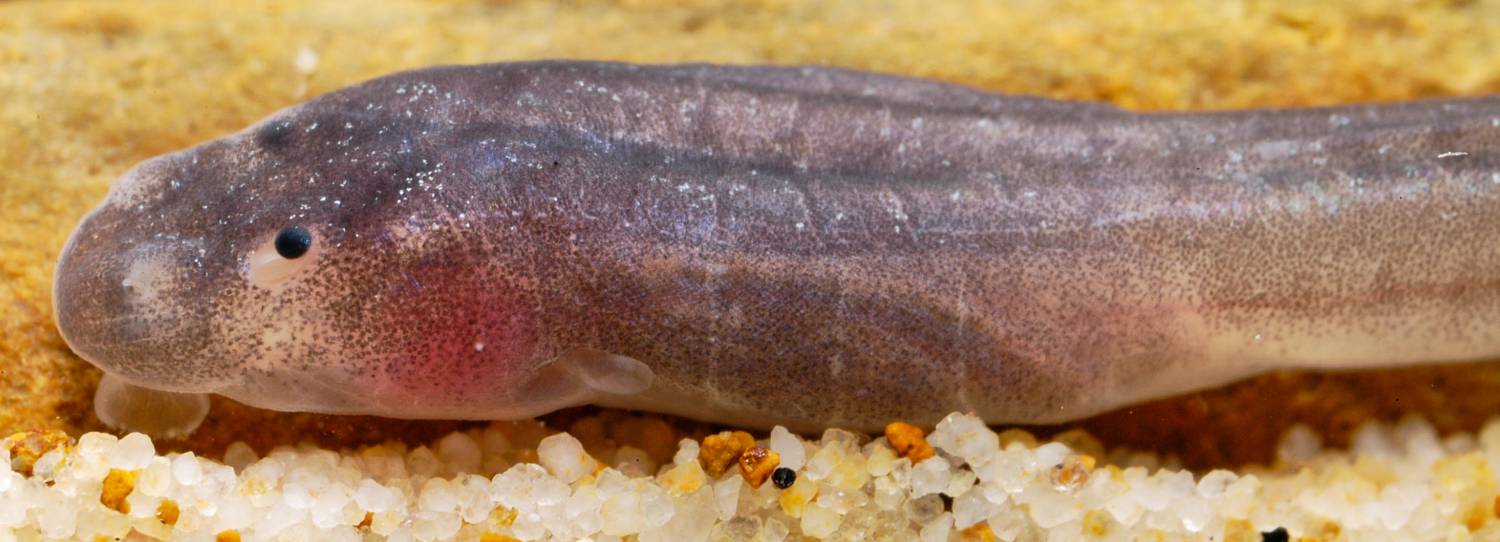
In live specimens, the skin of the upper body and tail shows a bluish iridescence. In advanced tadpoles, the upper head, upper trunk, and tail are brown pigmented. This pigmentation fades gradually toward the ventral side. Buccal, gill, and abdominal skin are semitransparent and lack brown pigmentation. Gills and heart are visible as reddish areas shining through the skin. Gut coils are visible in ventral and lateral views. Tail fins are semitransparent and moderately dusted with brown pigment cells, probably less pigmented in early larval stages. A few scattered silvery bluish iridophore dots are present on the dorsal surface of the head and body and along the upper parts of the tail base. Myosepta are accentuated by pigmentation, and the lateral tail vein is visible.
Snout
Broadly rounded, blunt, and moderately long in dorsal view, the snout is set off from the posterior part of the head by a shallow convexity. In lateral view, the head slopes smoothly downward into the rounded snout, giving it a blunt conical shape. In profile, the nostril is elevated on a small bulge.
Oral Disc
Details of the oral disc could not be studied with confidence because only two specimens at relatively early developmental stages were available for examination. However, oral disc morphology conforms to the general condition in the genus Leptobrachella: the disc is funnel-shaped and conspicuously protrudes from the body.
Body
Midsized and elongate; tadpole eel-like. In lateral view, head and trunk are slightly depressed. In dorsal view, the body is slender, only slightly wider than the base of the tail. The body-tail transition is smooth. The trunk is elongate; the head is shorter than the trunk and weakly set off from it. The body is widest at the gill region or along the trunk. The spiracle is sinistral. The spiracular opening is free from the body wall, forming a free spiracular tube that opens posterolaterally. The opening is positioned anterior to the midpoint of the head-trunk length. Skin glands are absent.
Eyes & Nostrils
Eyes very small, positioned dorsolaterally, deep, and not protruding. Eyes are surrounded by an unpigmented white orbita. The nostril is closer to the snout than to the eye and oriented anterolaterally; its dorsal rim bears a distinct projection. Iris black.
Tail
Long, approximately 67% of total length. The muscular part of the tail is strongly developed and nearly as high as the body at the tail base. The dorsal fin begins posterior to the trunk-tail transition and remains low in the anterior part of the tail. It has a straight edge in the first third of the tail, followed by a very smooth but distinct change in curvature; in the posterior two thirds, the dorsal fin follows a slightly convex contour. The lower fin starts at the trunk-tail transition. Upper and lower fins are similar in maximum height. Both fins converge into a rounded tip.
Similar Species
Only a few samples of Leptobrachella tadpoles have been collected to date, and sample sizes are generally small, making reliable species identification and differential diagnosis difficult. Currently, identification rests primarily on DNA barcoding. Differences among published descriptions of species should therefore be interpreted cautiously and in light of the limited available material. Leptobrachella tadpoles can be readily distinguished from all other Bornean tadpoles by the combination of their specific microhabitat, slender body shape, small eyes, and the unique morphology of the protruding oral disc. Inger (1985) provided a description of L. gracilis tadpoles that, based on locality information and subsequent taxonomic revisions, likely refers to larvae of a different Leptobrachella species, possibly L. fritinniens.
Literature
Males call from low vegetation along streams, usually less than 1 m above the ground. The vocal sack is bipartite. The twittering call has a dominant frequency between 7225–9190 Hz (frequency modulation).
Dehling, J. M., Matsui, M. (2013) A new species of Leptolalax (Anura: Megophryidae) from Gunung Mulu National Park, Sarawak, East Malaysia (Borneo). Zootaxa 3670: 33–44.
Inger, R.F. (1985) Tadpoles of the forested regions of Borneo. Fieldiana Zoology new series 26: 1–89.