Frogs of Borneo

Frogs of Borneo

Frogs of Borneo

Frogs of Borneo

Frogs of Borneo

Frogs of Borneo

Frogs of Borneo

Frogs of Borneo

Frogs of Borneo

Frogs of Borneo

Frogs of Borneo
Filter
Glyphoglossus brooksii
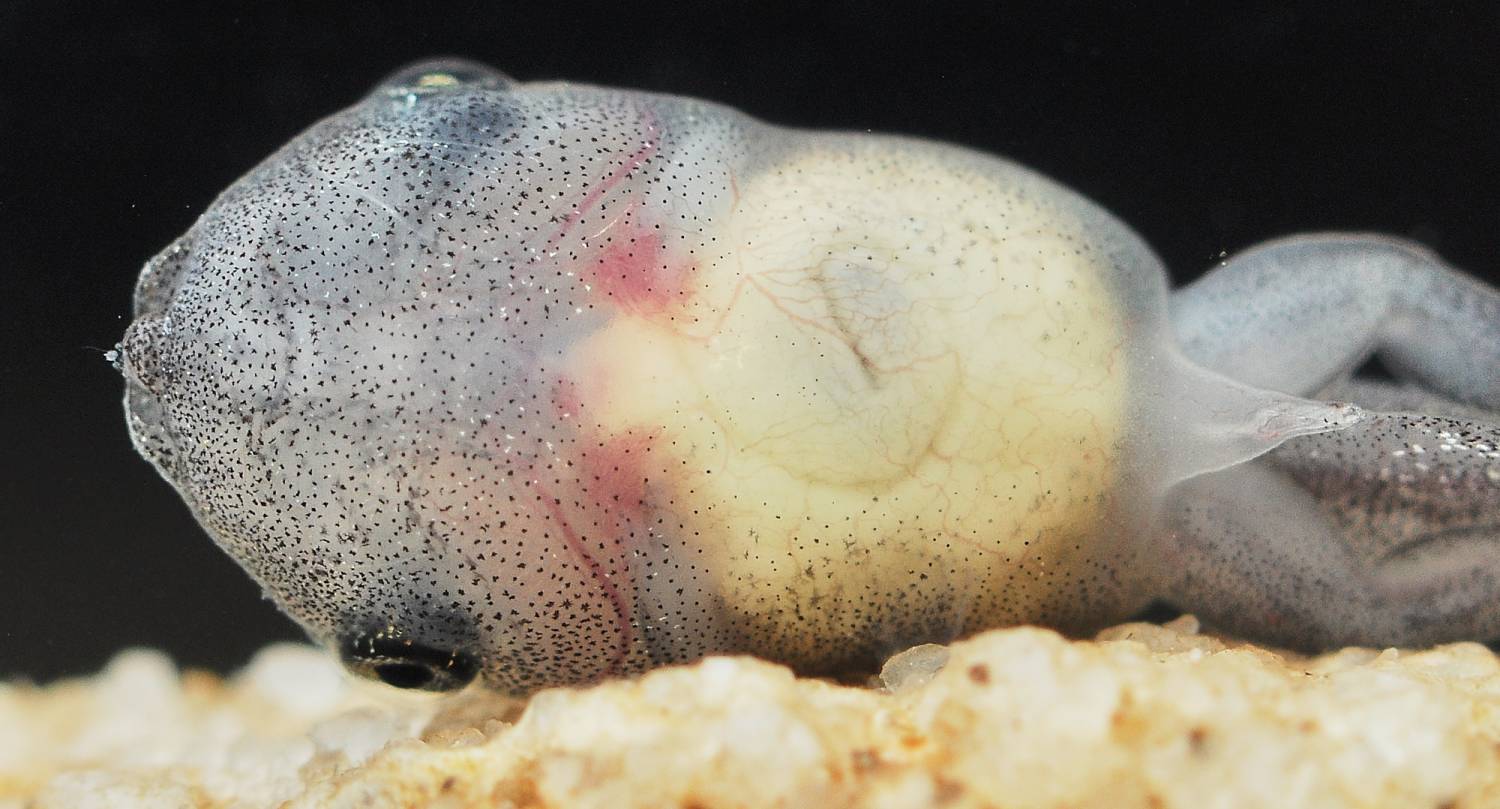
Like other, better-known species of the genus Glyphoglossus (Altig and Rowley 2014), G. brooksii has free-living tadpoles. Advanced larval stages observed were small and possessed a yellow gut coil. This may indicate yolk deposits in the gut and thus endotrophic development; however, further research is required to confirm this. Tadpoles were observed hovering in a pool of an intermittent forest stream. When suspended in the water column, Glyphoglossus tadpoles orient the body head-up at an angle to the surface, while the tail tip beats continuously to maintain position or enable slow movement. Upon disturbance, tadpoles rapidly dart to the bottom of the pool using strong tail beats.
-
Family:Microhylidae
-
Genus:Glyphoglossus
-
Ecomorph:lentic
-
Waterbody Type:stagnant
-
Water Column:mid-water to surface
-
Feeding Type:non-feeding
-
Size:25 mm
-
Development:larva, tadpole
-
Adult:Glyphoglossus
Coloration
Uniformly dark gray to black dorsally, without any distinct pattern, including the tail. Melanocyte density decreases along the flanks toward the ventral side. Under high magnification, a fine, light orbitonasal streak is discernible. The gut coil is visible in lateral and ventral views. Ventral gular and buccal regions dusted with melanocytes, the abdominal region less so. Loosely stippled with iridocytes dorsally, along the proximal half of the tail and its fins, and with some iridocytes also present in the ventral buccal region. Ventral skin translucent; heart and large blood vessels visible in ventral view.
Snout
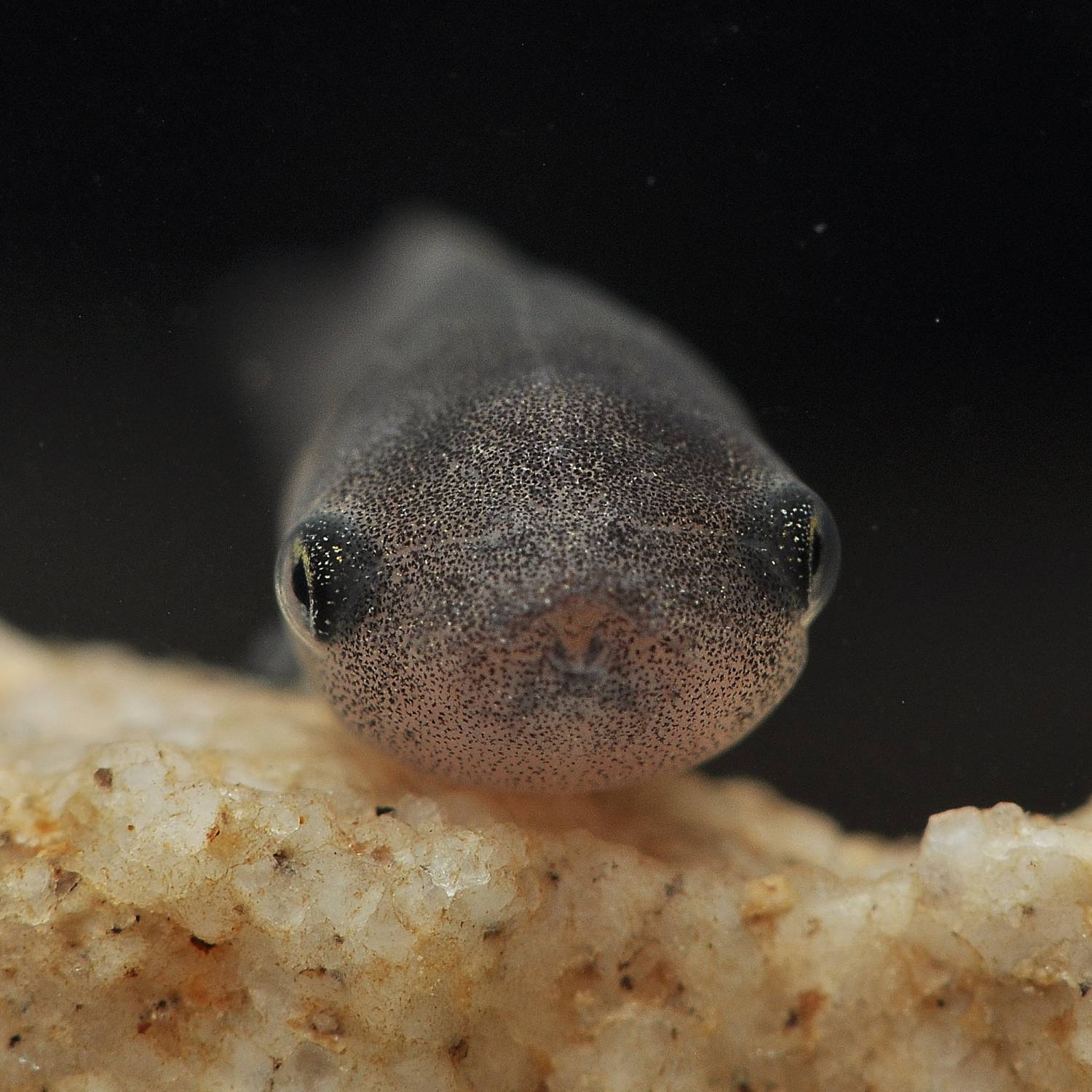
Short and bluntly rounded in dorsal view, except for a small medial truncation; snout blunt and rounded in lateral profile.
Oral Disc
Absent, except for tiny skin flaps below the lower jaw. Mouth terminal and slightly upturned. Keratinized jaw sheaths and keratodonts absent; LTRF (0/0).
Body
Small. Head and trunk approximately as wide as deep; head somewhat flattened dorsally. In dorsal view, body composed of a wider head and a narrower trunk. In lateral view, head bluntly rounded anteriorly. Body widest at the level of the gill region. Trunk much wider than the base of the tail. Spiracle ventral and median in position; spiracular opening directed posteriorly at the level of the anterior abdomen. Rim of the spiracular orifice smoothly squared. Lateral line organs indistinct.
Eyes & Nostrils
Eyes positioned laterally; cornea protruding beyond the body contour in dorsal and ventral views. Iris metallic and shiny, with scattered golden iridocytes on a black background dorsally and more silvery iridocytes ventrally, except for a conspicuous iridocyte-free black indentation in the ventral part of the iris. Nostrils not perforated in larval stages; the position of the future nostril often difficult to discern and presumed to be at the termination of the orbitonasal streak. Nostrils closer to the snout than to the eye.
Tail
Up to 74% of total length. Muscular part of tail moderately developed and much lower than the body in lateral view. Upper fin rising at the trunk-tail junction, with an almost straight contour and only slight posterior convexity. Lower fin more strongly arched and clearly higher than the upper fin. Both fins taper posteriorly into a long, flagellate tip. Skin glands absent. Lateral tail vein indistinct. Muscle myosepta slightly accentuated by pigmentation.
Similar Species
The combination of body shape, laterally positioned eyes, ventral black indentation in the iris, vestigial oral disc, and tail fin morphology (higher lower fin, flagellate tip) is unique for Glyphoglossus, making confusion with any other Bornean genus unlikely. Species of Microhyla share some of these characters but usually exhibit distinct body or tail color patterns, which are absent in Glyphoglossus brooksii. For Glyphoglossus tadpoles, see also Altig and Rowley (2014). For Borneo, tadpoles of other Glyphoglossus species remain unknown, although a photograph is provided to the right.
Literature
The males respond strongly to rainfall with their calls. Calls have been reported during the day. The rather small size relative to stage of the tadpoles suggests that development might take only a few weeks.
Altig, R., Rowley, J. (2014) The breeding behavior of Glyphoglossus molossus and the tadpoles of Glyphoglossus molossus and Calluella guttulata (Microhylidae). Zootaxa 3811: 381–386.