Frogs of Borneo

Frogs of Borneo

Frogs of Borneo

Frogs of Borneo

Frogs of Borneo

Frogs of Borneo

Frogs of Borneo

Frogs of Borneo

Frogs of Borneo

Frogs of Borneo

Frogs of Borneo
Filter
Ansonia echinata

The ecology of this species remains poorly documented. Specimens have been collected at Bukit Kana (250 m a.s.l.) and within Batang Ai National Park, where they inhabit large, clear, rocky streams characterized by waterfalls, torrents, and riffles in lowland secondary forest, at elevations up to 1315 m a.s.l. Larvae occur in fast-flowing torrents and attach to smooth rock substrates. Syntopic tadpoles include Ansonia kanak, Meristogenys sp., and Huia cavitympanum.
-
Family:Bufonidae
-
Genus:Ansonia
-
Ecomorph:exotrophic, lotic, rheophilous, suctorial
-
Waterbody Type:flowing
-
Water Column:rock surface
-
Feeding Type:feeding, hard surface grazer, omnivorous, rasping
-
Size:26 mm
-
Development:larva, tadpole
-
Adult:Ansonia
Coloration
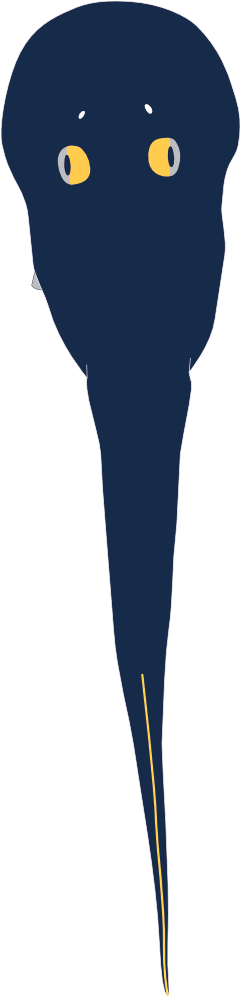
Uniformly dusted dark brown to gray dorsally, with darker pigmentation concentrated in the central region of the dorsum. Pigmentation gradually extends from the body onto the muscular portion of the tail and into the tail fins, which are more densely pigmented toward their margins. Numerous golden iridocyte spots are densely scattered over the body and tail. The venter is unpigmented in the premetamorphic stages examined, rendering internal organs visible. As in congeners, progressive ventral pigmentation is expected in more advanced developmental stages. The oral disc is unpigmented.
Snout
Broadly expanded; long and gradually sloping in lateral profile, resulting in a streamlined appearance. In dorsal view, the snout is very broad.
Oral Disc
Oral disc forming a large ventral sucker, nearly as wide as the maximum body width. Lips not emarginated. Lower lip bearing a single row of low marginal papillae; upper lip forming a smooth bulge. Two to three rows of submarginal, flattened papillae present on the lower lip. Labial keratodont rows all undivided; LTRF 2/3. Upper keratodont rows very long, extending well beyond the lateral ends of the lower rows and curving inward distally. Upper beak widely divided, lacking medial keratinization. Lower beak undivided, broadly angled, and flat.

Body
Body contour inverted pear-shaped in dorsal view, narrowing markedly posterior to the level of the eyes. In lateral view, body dorsoventrally depressed. Abdomen flat, not bulging. Spiracle sinistral, tubular, attached to the body wall, and positioned well below the midlevel in lateral view. Intestines coiled. Lateral line organs indistinct.
Eyes & Nostrils
Eyes dorsolateral, positioned far from the body margin in dorsal view. Nostrils small and elliptical, located dorsally and directed anterolaterally, situated much closer to the eyes than to the tip of the snout. Each nostril bears a marginal rim and a small triangular fleshy projection on the medial margin. Iris black, with a copper-colored ring bordering the pupil.
Tail
Tail strong and muscular, almost as high as the body in lateral view. Fins relatively low. Dorsal fin confined to the posterior 50% of the tail. Ventral fin forming a low, soft keel along most of the tail length, increasing in height only in the posterior 50%. Both fins slightly arched, with the ventral fin marginally higher than the dorsal fin. Fins taper gradually and terminate in a pointed tip. Myosepta slightly accentuated by pigmentation.
Similar Species
Tadpoles of most Ansonia species are distinctive in body shape, characterized by an inverted pear-shaped outline in dorsal view. Within the genus, species can be differentiated by combinations of oral disc morphology, body shape and size, coloration, elevational distribution, and tail characteristics, particularly fin extent. Ansonia echinata shares with A. hanitschi the presence of very long, inward-curving upper keratodont rows. Tadpoles of A. hanitschi are adapted to higher elevations and attain larger sizes, although A. echinata may grow larger than currently documented. In overall appearance, tadpoles of A. echinata superficially resemble those of A. minuta. Inger and Stuebing (2009) illustrated two “cruciform” tadpoles found in association with adult A. echinata at Bukit Kana; however, these larvae were not identified using molecular data. Based on DNA-confirmed material from the same locality, both cruciform tadpoles are here considered to belong to other Ansonia species. The syntopic larvae of A. kanak, however, are readily distinguishable by differences in coloration and oral disc morphology.
Literature
Inger and Stuebing (2009) mentioned males perching on low vegetation, within 3.5 m from the water's edge. We observed adults resting and calling on low vegetation (small shrubs) near waterfalls.
Inger, R.F., Stuebing, R.B. (2009) New species and new records of Bornean frogs (Amphibia: Anura). The Raffles Bulletin of Zoology 57: 527–535.